
What does harmonium bellows repair involve?
The safe sequence is observe, isolate, record, and then decide whether a technician is needed. Do not start by opening the reed board or applying glue.
Harmonium bellows repair means restoring the instrument's ability to move and hold air. The outside folds, corner joints, valves, air chamber, and glue or cloth seals can all contribute to a leak. A player should first describe the symptom and confirm that it repeats under the same note, stop, and pumping conditions.
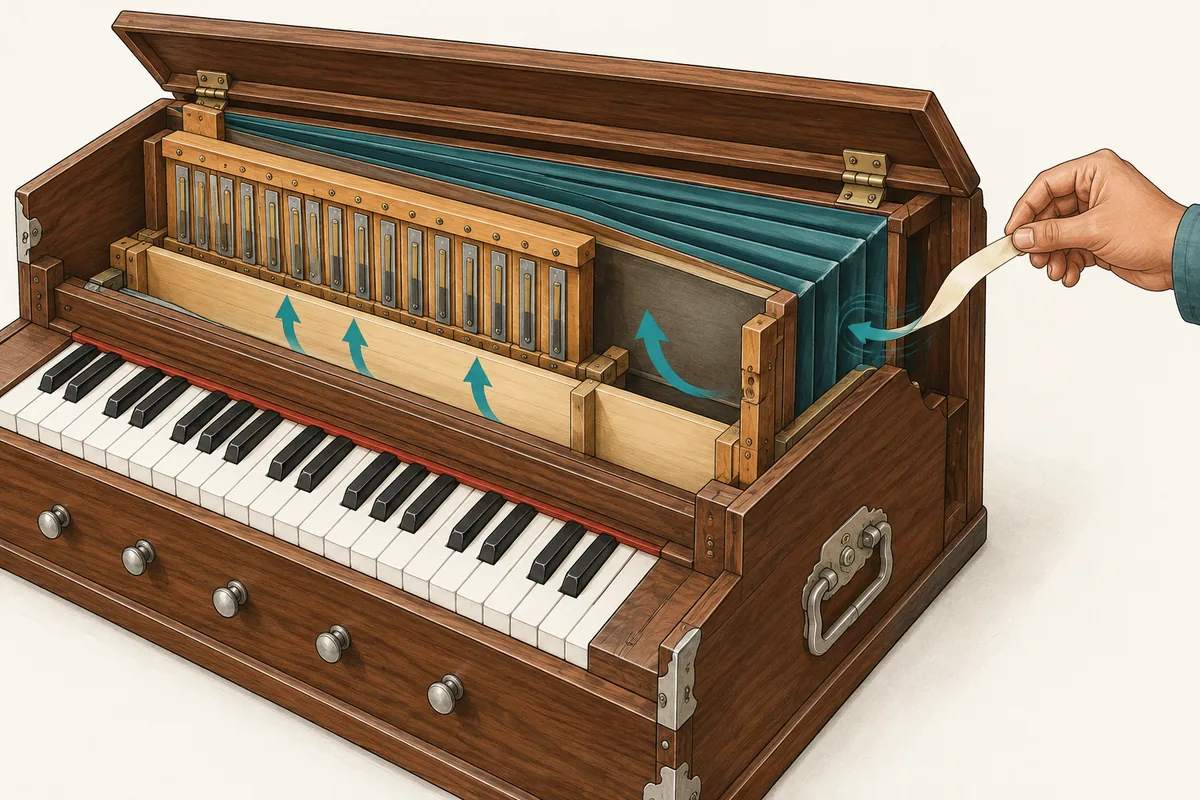
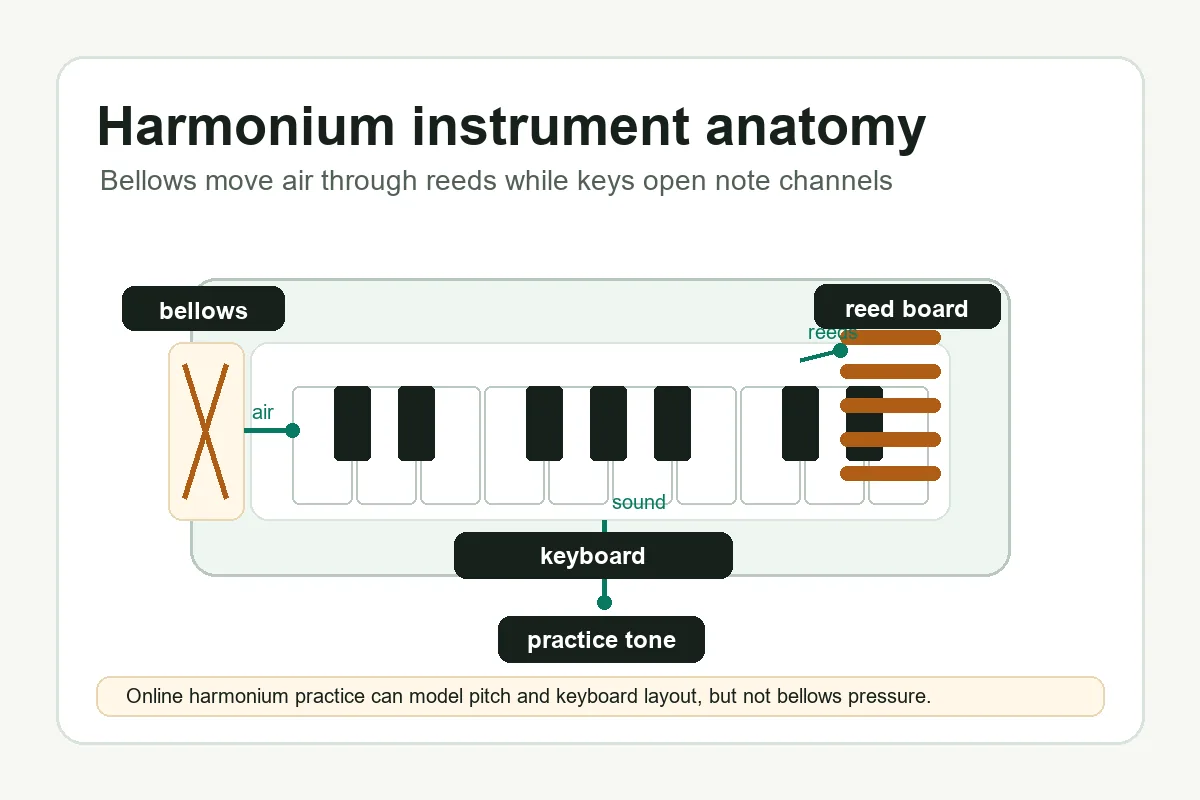
Start with the least invasive check. Close the stops, play one comfortable note, and pump slowly. If the sound fades while the key stays down, listen for a hiss and watch the bellows folds. The broader harmonium instrument guide explains how air, keys, valves, and reeds work together.
A leak test does not prove which internal part needs replacing. It only tells you whether air is escaping and where the symptom is strongest. That distinction matters because a loose fold, a tired valve, and a reed problem can sound similar during a hurried practice session.
Signs that a harmonium bellows may be leaking
The most useful clue is a change in air behavior rather than a single unusual note. A bellows leak may make the instrument lose volume during a held note, require more pumping than usual, or create a faint whistle when the stops are closed. Compare the same note with one stop and a nearby note so that reed balance does not hide the change.
Check whether the symptom follows the bellows position. If the note is strong at the beginning of a stroke and weak at the end, the air reserve or a fold seal may be involved. If the note is weak only with one stop, the reed bank or valve may be the better lead. Keep these observations separate in your notes instead of calling every quiet note a bellows failure.
| Symptom | Low-risk comparison | What it may suggest |
|---|---|---|
| Air fades while one key is held | Repeat the same note with one stop and slow pumping | Leak, valve seating, or air-chamber loss |
| Soft hiss near a fold | Move the bellows slowly and listen without pressing harder | Cloth seam, corner, or loose joint |
| Only one stop sounds weak | Close other stops and compare a nearby key | Reed or valve issue rather than the whole bellows |
| Bellows feels loose or uneven | Inspect visible folds with the case level | Detached support, worn fold, or warped panel |
A gentle ten-minute harmonium bellows leak test
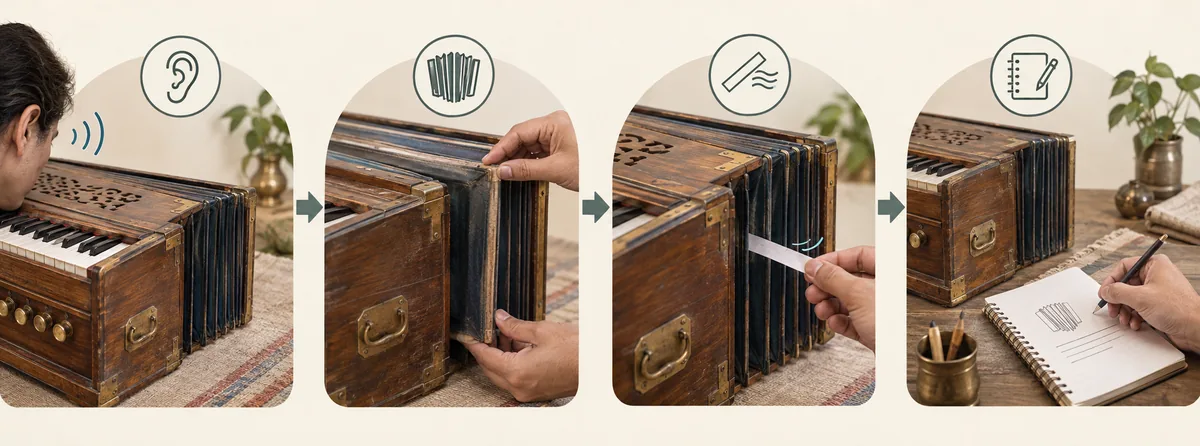
Perform the test on a stable table with clean, dry hands. The purpose is to find a repeatable location, not to create pressure that the instrument would never see during playing. Remove loose covers, close the stops, and keep drinks, oils, compressed air, and metal tools away from the opening.
Use a narrow strip of ordinary paper only near the outside of a suspected fold. If the strip moves, that is a clue that air is escaping; it is not a reason to push the paper into a seam. You can also use your ear and a small piece of tissue held a short distance away. Stop if the cloth catches or the panel flexes.
-
1
Prepare the instrument
Place the harmonium level, close stops and couplers, release the bellows gently, and make sure the room is quiet enough to hear a small hiss.
-
2
Choose one reference note
Play a middle-range note with one stop. Pump slowly and hold the key for several seconds; do not increase force when the air begins to fade.
-
3
Isolate the outside folds
Move the bellows through a normal stroke and listen near each visible fold. Hold a paper strip or tissue just outside the suspected area.
-
4
Repeat the clue
Release the key, wait, and repeat the same note and stroke. A clue that appears twice is more useful than a one-time sound.
Never use superglue, household tape, oil, or wet adhesive as a first response. These materials can stiffen cloth, block movement, and make a later repair harder.
What you can check at home and what you should not repair
Home care is appropriate when it stays visible, dry, and reversible. You can remove dust from the outer case with a soft cloth, check that a stop is fully open or closed, look for loose objects near the keys, and compare bellows movement without force. These checks help you describe the problem and may remove a simple obstruction.
Internal bellows work is different. Replacing cloth, reseating a valve, opening an air chamber, trimming a fold, or applying adhesive changes the instrument's pressure and alignment. Even a small patch can rub against a moving panel or create a new leak. A repairer can choose material, glue, and tension after seeing the exact construction.
| Reasonable at home | Pause and ask a technician | Why the boundary matters |
|---|---|---|
| Dry-wipe the outside and cover | Torn cloth or detached fold | A patch must flex without rubbing or leaking |
| Check visible hinges and case position | Warped panel or loose air chamber | Pressure can move a panel that looks stable |
| Repeat one-note symptom test | Valve replacement or reed-board removal | The wrong part can change airflow and pitch |
Bellows care, storage, and prevention
Bellows last longer when the instrument is stored level, protected from direct sun, and kept away from damp walls, heaters, kitchens, and car boots that swing between hot and cold. Use a breathable cover and do not stack heavy cases on top. Sudden wet-dry cycles can move wood joints and make cloth or adhesive brittle.
After practice, let the bellows relax according to the instrument's normal closing design. Do not clamp the folds shut with extra pressure and do not leave a key or stop partly engaged. Wipe hands before playing; skin oil and dust around the keyboard eventually travel into places that are harder to clean.
Do not use a household vacuum nozzle, compressed air, furniture polish, or scented oil near bellows cloth or reed openings.
When to call a harmonium technician
Arrange professional help when the leak repeats after a careful test, when a fold is split, when air escapes from a hidden joint, or when the instrument cannot hold a steady note. A technician may need to remove panels, test valve seating, inspect the air chamber, replace cloth or gasket material, and check the reeds after the airflow is restored.
Ask for a diagnosis that names the work: external seam repair, bellows cloth replacement, valve service, air-chamber work, cleaning, or tuning. These are not interchangeable jobs. A low-cost patch may be sensible for a practice instrument, while a valuable or historic harmonium may need compatible materials and slower restoration.
-
1
Describe the symptom
State whether volume fades, a hiss appears, or the bellows feels uneven, and say whether the clue repeats with one note and stop.
-
2
Share the instrument context
Give the model, approximate age, recent move, room conditions, and whether the harmonium was exposed to moisture or heat.
-
3
Ask what the estimate includes
Separate inspection, cloth or valve work, cleaning, tuning, transport, and follow-up so the price is tied to a defined job.
- Encyclopaedia Britannica: harmonium - Background on the harmonium as a keyboard free-reed instrument.
How to check a repaired bellows without overworking it
When the instrument comes back, let it reach the room temperature recommended by the repairer before testing. Begin with one stop and a moderate stroke. Check a low, middle, and high note, then repeat the original symptom test. A repaired bellows should be judged by steady, normal playing behavior, not by maximum pressure.
Listen for new rubbing, a stiff fold, a smell of uncured adhesive, or a note that changed after the air work. Write down the settings that sound normal and ask the repairer about any remaining limitation. Some older instruments have more than one issue, so a bellows repair may reveal a separate reed or valve problem without being a failure.
A repair is successful when the instrument behaves predictably for its intended use. It does not promise identical pressure, pitch, or response across every key.
Harmonium bellows repair FAQ
How can I tell if my harmonium bellows are leaking?
Close the stops, hold one note, and pump slowly. A repeatable hiss, fading volume, unusually short air reserve, or a paper strip moving near an outside fold suggests escaping air. Repeat the same test before deciding what needs repair.
Can I repair a harmonium bellows with tape?
Tape is not a dependable first repair. It can stiffen the fold, leave residue, rub against moving parts, and hide the actual tear. Keep the instrument in its normal closed position and ask a technician about compatible cloth or gasket work.
Why does my harmonium lose air when I hold a key?
Possible causes include a bellows leak, a valve that does not seat, an air-chamber leak, or a stop and reed combination that changes the demand. Repeat the note with one stop and record where the air fades instead of pumping harder.
Is a soft hiss always a bellows problem?
No. A stop, valve, reed opening, or loose panel can also make a hiss. Compare a nearby note, close extra stops, and listen near the visible folds. A technician can separate the air path from the reed path during inspection.
How much does harmonium bellows repair cost?
The cost depends on the tear, material, access, transport, local labour, and whether cleaning or tuning is also needed. An online price cannot diagnose the instrument. Ask for an estimate that lists inspection, bellows work, valve work, and tuning separately.
Record the clue before you repair the cause
A repeatable note, fold location, and short symptom record give a technician a better starting point than an improvised patch. Use the browser harmonium for note practice while the physical instrument is being serviced.
Open the online harmonium