
What is a harmonium instrument?
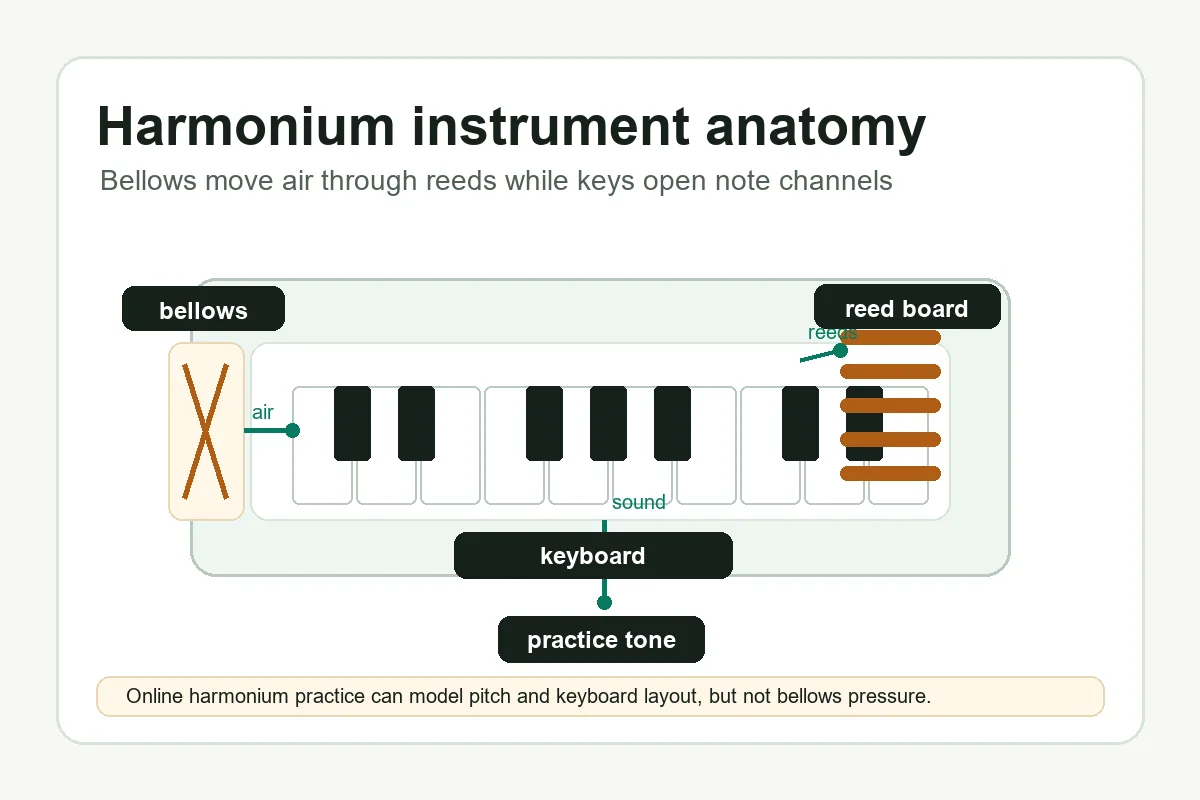
A harmonium is a free-reed keyboard instrument. The player pumps bellows to push air through metal reeds, then presses keys to choose which reed channels open.
The sound is steady, vocal, and sustained, which is why harmoniums are often used for Indian classical vocal practice, bhajan singing, kirtan, devotional accompaniment, and sargam drills.
The simplest way to picture a harmonium instrument is to imagine a keyboard connected to a small air system. The keys do not strike strings like a piano. Instead, each key opens a path for air. When air passes over a reed, the reed vibrates and produces a pitch.
A physical harmonium also teaches touch, air control, and musical breathing. A browser-based online harmonium keyboard cannot copy the feel of bellows pressure, but it can help beginners learn pitch centers, note names, keyboard direction, sargam patterns, and short melody checks.
If you are comparing physical instruments before buying, use the harmonium price guide to separate beginner cost, reed quality, tuning, shipping, and repair risk.
Search intent note: this page explains the instrument itself. If you already want a playable tool, start with the online harmonium on the homepage.
Keyword boundary: this guide is not a buying guide and does not replace a detailed repair manual.
Main harmonium parts and what each one does
Most harmoniums share the same working idea even when the case size, reed quality, number of stops, and decorative details change. For a beginner, the most important parts are the bellows, air chamber, reeds, keys, stops, drones, couplers, and outer case.
Understanding these parts makes practice less mysterious. When the tone feels weak, the problem may be air supply. When one note sounds dull, the issue may be a reed or valve. When a scale feels confusing, the keyboard map and chosen Sa usually need attention.
| Part | What it does | Beginner practice tip |
|---|---|---|
| Bellows | Push air into the instrument so the reeds can vibrate. | Pump smoothly. Uneven pumping makes notes pulse or fade. |
| Keys | Open note channels when pressed. | Learn the left-to-right keyboard direction before memorizing songs. |
| Reeds | Metal tongues that vibrate and create the pitch. | Listen for steady tone. A buzzing or silent note may need repair. |
| Stops | Open or close groups of reeds or airflow paths. | Start with a simple sound before adding multiple stops. |
| Drones | Hold a fixed support note on some instruments. | Use them only when the drone matches the chosen Sa or Pa. |
| Coupler | Adds another octave or paired note on some models. | Keep it off while learning clean note accuracy. |
| Case | Holds the keyboard, reeds, bellows, and air chamber. | Keep the instrument level and protected from dust and moisture. |
How a harmonium instrument makes sound
A harmonium makes sound through airflow and reed vibration. The player pumps the bellows, air collects in the chamber, and a pressed key opens a valve. Air then passes through a reed slot. The reed vibrates rapidly, and that vibration becomes the note you hear.
Because the tone can continue as long as air is supplied, the harmonium feels different from a piano. A piano note starts with a hammer strike and then fades. A harmonium note can be sustained, shaped, and connected to singing phrases. That sustained quality makes it useful for vocal warm-up and pitch reference.
Why bellows control matters
Bellows control is part of the musical expression. Too little air can make the tone unstable. Too much force can make the sound harsh or uneven. Good players learn to keep pressure steady while changing notes, singing, or accompanying someone else.
This is the main area where a physical instrument still matters. Online practice can teach pitch and layout, but it cannot build the hand coordination needed for air pressure.
Why reeds shape the harmonium tone
Different reed sets can sound bright, mellow, sharp, nasal, or full. Some instruments include multiple reed banks so the player can combine tones. A beginner does not need to master every stop immediately. A clean single-reed sound is usually better for learning accurate notes.
Common harmonium uses in practice and performance
The harmonium instrument is strongly associated with Indian vocal music, devotional singing, and teaching. It is portable enough for lessons, loud enough to support group singing, and stable enough to hold a pitch center while a student repeats a phrase.
Singers often use it to establish Sa, rehearse alankars, learn raga phrases, support bhajan or kirtan, and check whether a melody line rises or falls correctly. Teachers use it because the keyboard gives a visible map while the reed tone stays close to vocal practice.
If your goal is raga or vocal study rather than instrument anatomy, continue with the harmonium in Indian classical music guide for Sa reference, accompaniment, and raga-practice limits.
-
1
Find a comfortable Sa
Choose a pitch where the singer can begin without strain. Do not force every voice into the same fixed key.
-
2
Play a short scale slowly
Use Sa Re Ga Ma Pa and return to Sa before practicing a song. This checks both pitch memory and keyboard direction.
-
3
Practice one phrase
Repeat a short melodic line until the note order is stable. Add rhythm only after the pitch is clear.
-
4
Use support notes lightly
A drone or sustained Pa can help, but it should not cover mistakes in the melody.
Harmonium vs piano, organ, and accordion
A harmonium may look familiar because it has a keyboard, but it behaves differently from a piano. It is closer to other free-reed or air-driven instruments because the sound depends on airflow and vibrating reeds rather than struck strings.
The difference matters for learning. Piano practice emphasizes attack, decay, finger independence, and harmony. Harmonium practice emphasizes sustained pitch, vocal support, sargam movement, and coordination between keys and airflow.
| Instrument | Sound source | What beginners notice |
|---|---|---|
| Harmonium | Air passes through metal reeds. | Sustained tone, movable Sa practice, bellows coordination. |
| Piano | Hammers strike strings. | Strong attack, fading note, wide dynamic range. |
| Pipe or reed organ | Air system activates pipes or reeds. | More organ-like layout, often larger and less portable. |
| Accordion | Bellows and reeds with button or keyboard layout. | Bellows are moved by pulling and pushing the instrument body. |
For online learning, a virtual keyboard can introduce note positions. It should not be confused with learning physical bellows expression.
Beginner plan: learn the harmonium instrument without getting lost
New players often try to learn songs before they can identify notes, choose Sa, or keep air steady. A better path is to separate three skills: instrument understanding, keyboard note mapping, and melody practice.
Start with the instrument parts so you know what your hands are doing. Then use the how to play harmonium guide for your first practice routine, learn the note map with the harmonium notes for beginners guide, and move into song phrases with the Hindi song harmonium notes guide.
-
1
Day 1: identify the parts
Find the bellows, stops, keys, and any drone or coupler controls. Play only a few notes and focus on steady sound.
-
2
Day 2: learn Sa Re Ga Ma
Use C as a temporary Sa if you need a simple map, then learn that Sa can move for singing.
-
3
Day 3: repeat a five-note pattern
Practice Sa Re Ga Ma Pa and Pa Ma Ga Re Sa slowly, saying the note names aloud.
-
4
Day 4: test one short melody
Choose a short phrase, map the notes, and check the direction before adding speed.
How online harmonium practice fits with the real instrument
An online harmonium is useful when the real instrument is not nearby. It can help you hear a pitch, test a phrase, choose a comfortable root, review a note chart, and keep a short practice habit alive. This is especially useful for students who only meet a teacher once a week.
Use online practice for note recognition and quick checking. Use a physical harmonium for bellows control, touch, volume balance, and performance expression. The two formats work best together when each one has a clear job.
- Encyclopaedia Britannica: harmonium - overview of the harmonium as a free-reed keyboard instrument.
- Encyclopaedia Britannica: free-reed instrument - background on the reed principle behind harmoniums and related instruments.
Harmonium instrument FAQ
Is a harmonium instrument the same as a piano?
No. A piano uses hammers and strings, while a harmonium uses air and vibrating reeds. The keyboard may look familiar, but the sound behavior and practice goals are different.
Why is the harmonium useful for singers?
It can hold a steady pitch, support Sa, and make melodic movement clear. This helps singers repeat sargam, raga phrases, bhajans, and warm-ups.
Can beginners learn harmonium online first?
Yes, online practice can teach note direction, keyboard layout, and simple phrase checking. Beginners still need a real instrument to learn bellows pressure and touch.
What harmonium parts should I learn first?
Start with bellows, keys, reeds, stops, and drones. Those parts explain most of what you hear and most beginner setup problems.
Does a harmonium need tuning?
Yes. Reeds can drift, buzz, or become uneven over time. Tuning and reed repair should usually be handled by someone experienced with harmoniums.
Hear the harmonium layout in your browser
Use Web Harmonium to test Sa, repeat a short scale, and connect this instrument guide with real keyboard practice.
Open the online harmonium