
Quick answer: how do you play harmonium as a beginner?
To play harmonium as a beginner, sit straight, open a simple reed stop, pump the bellows smoothly, choose one note as Sa, then play Sa Re Ga Ma Pa slowly with your right hand. Keep the first session short and accurate before adding speed or songs.
If you are using an online harmonium, the same order still helps: set volume low, choose a comfortable pitch with transpose, play a five-note pattern, then test one short phrase. Online practice teaches pitch and keyboard layout, while a physical harmonium teaches bellows pressure and touch.
Many beginners search for how to play harmonium because they want an immediate song. That is understandable, but the first lesson should build orientation. A harmonium is a keyboard instrument, yet its musical job in Indian vocal practice is often to support Sa, sargam, raga phrases, bhajans, and melody checking rather than to play big piano-style chords.
Use this page as a practical bridge between the harmonium instrument overview, the harmonium notes chart, and real song practice. The goal is a clean first routine: find Sa, play a short pattern, hear mistakes clearly, and repeat without tension.
Set up the harmonium before playing your first notes
Good setup prevents most beginner problems. Place the harmonium on a stable surface or the floor, sit where your right hand reaches the middle keys without twisting, and keep your shoulders relaxed. If the instrument has stops, open one simple reed stop first. Avoid couplers and heavy drone combinations until you can hear single notes clearly.
For a physical instrument, pump the bellows gently before pressing a key, then keep the motion even. Uneven bellows pressure can make a correct note sound weak, jumpy, or late. For an online harmonium, start with moderate volume and no extra reverb so wrong notes are easy to hear.
If you have not bought an instrument yet, check the harmonium price guide before paying for a scale changer, extra reeds, or a used model that may need repair.
| Setup choice | Beginner default | Why it matters |
|---|---|---|
| Posture | Sit upright with relaxed shoulders | A stable body keeps the right hand accurate and the left hand calm. |
| Stops | Use one clear reed stop | A simple tone exposes note mistakes better than a thick sound. |
| Bellows | Pump evenly, not aggressively | Steady air keeps the pitch and volume consistent. |
| Online settings | Low volume, middle octave, light or no reverb | A dry sound helps you check Sa Re Ga Ma clearly. |
Choose Sa before learning notes or songs
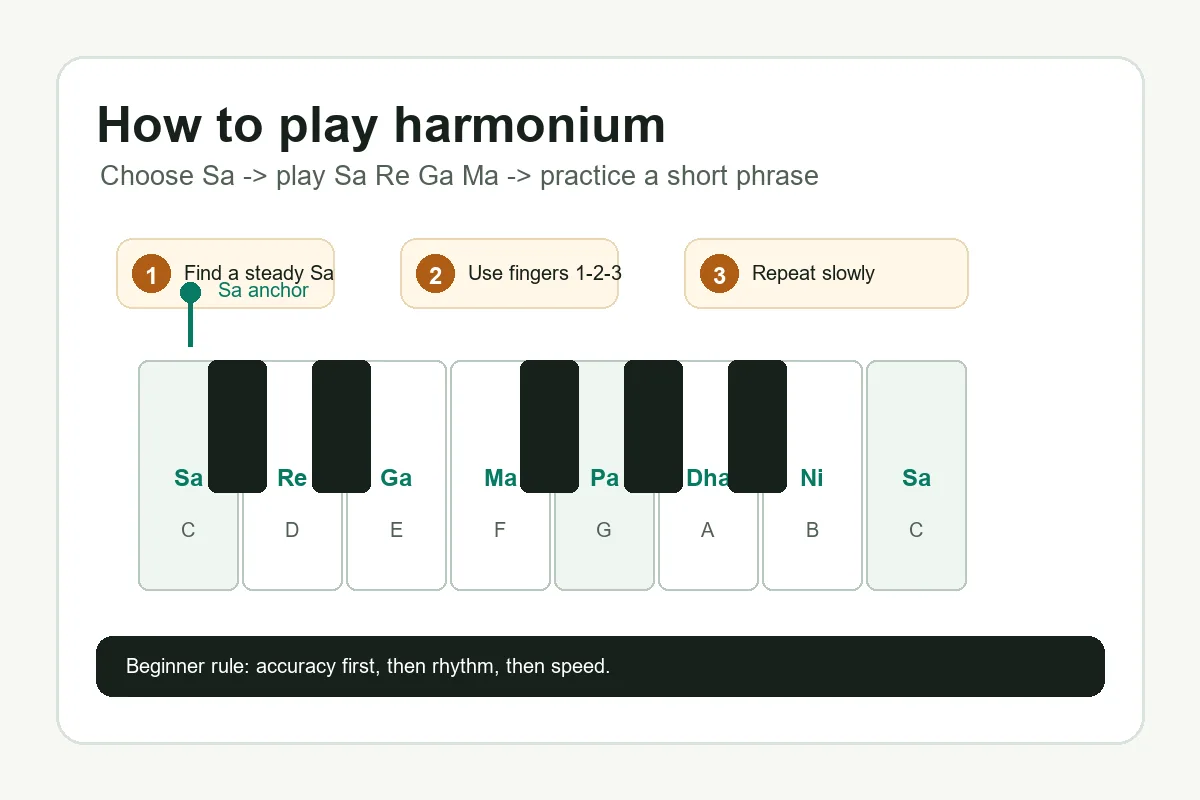
Sa is the home note. In many beginner charts, C is used as a temporary Sa because it is easy to see on a keyboard. In real singing practice, Sa is movable. A teacher or singer may choose C, D, E, F, or another pitch depending on vocal comfort.
Do not treat every written Sa as the physical C key. If you are learning a song from sargam, first ask: where is Sa for this version? Once Sa is chosen, Re, Ga, Ma, Pa, Dha, and Ni follow from that center. This one habit prevents a large number of beginner mistakes.
-
1
Use C as a starter map
For the first lesson, play C as Sa so you can see a simple left-to-right pattern.
-
2
Sing or hum the note
Check whether that Sa feels comfortable. If it strains the voice, transpose the pattern.
-
3
Keep the same note names
When Sa moves, the sargam names move with it. The finger shape can stay similar while pitch changes.
-
4
Write the chosen Sa
Before practicing a song, mark the selected Sa beside the title or lesson notes.
Right-hand fingering for Sa Re Ga Ma practice
Beginners often use one finger for every note. That works for testing a sound, but it slows you down and makes phrases uneven. Start with a simple right-hand pattern: thumb for Sa, index for Re, middle for Ga, then shift carefully for Ma and Pa as the phrase extends.
Do not worry about advanced fingering rules at the beginning. The first goal is consistency. Use the same finger for the same note during one exercise, play slowly enough to hear each pitch, and keep the wrist relaxed instead of lifting the hand high after every key.
| Exercise | Notes | Practice focus |
|---|---|---|
| Five-note climb | Sa Re Ga Ma Pa | Even spacing between notes. |
| Five-note return | Pa Ma Ga Re Sa | Descending accuracy, not speed. |
| Three-note loop | Sa Re Ga, Re Ga Ma | Small finger movement without tension. |
| Phrase check | Sa Re Ga, Ga Re Sa | Make the line sound musical, not mechanical. |
What the left hand does on a real harmonium
On a physical harmonium, the left hand usually works the bellows. This is why harmonium feels different from an online keyboard. Your left hand is not just moving a box; it is feeding the air that lets the reeds speak. Smooth air makes a simple note sound confident.
For the first week, avoid dramatic pumping. Press one note, pump gently, and listen for a steady tone. Then change notes while keeping the air even. If the volume surges every time your right hand moves, slow down and separate the two tasks.
Online harmonium practice cannot train bellows control. Use it for pitch, note order, and quick phrase checks, then confirm touch and air pressure on a real instrument.
If your harmonium has a coupler, leave it off during beginner drills. Extra octave doubling can hide uneven fingering.
A 15-minute first harmonium practice routine
A short routine is better than a long unfocused session. The first routine below works for a real instrument and can be adapted to the online harmonium keyboard. Stay slow enough that you can name the notes while playing them.
Do not measure progress by how many songs you touch. Measure it by whether Sa is stable, whether your ascending and descending patterns match, and whether one short phrase becomes easier after several repeats.
-
1
Minutes 1-3: set sound and Sa
Open one clear sound, choose Sa, and play it several times until the tone feels steady.
-
2
Minutes 4-7: play Sa Re Ga Ma Pa
Climb and return slowly. Say the note names aloud as you play.
-
3
Minutes 8-10: repeat a three-note loop
Use Sa Re Ga, Re Ga Ma, and Ga Ma Pa to improve small movements.
-
4
Minutes 11-13: test one phrase
Choose a tiny melody line or sargam fragment and map it note by note.
-
5
Minutes 14-15: review mistakes
Write down the note that felt unclear, then repeat only that small movement.
A 15-minute step-by-step harmonium lesson
Use this short lesson when you want a repeatable answer to how to play harmonium step by step. Accuracy, steady air, and relaxed fingers matter more than speed.
Minutes 0-3: sit with relaxed shoulders, choose one reed, and make the bellows sound even. Minutes 3-6: choose Sa and play Sa Re Ga Ma Pa upward and downward. Minutes 6-10: repeat Sa Re Ga, Re Ga Ma, and Ga Ma Pa with the same fingering. Minutes 10-13: play one short song phrase slowly. Minutes 13-15: listen back, note one uneven transition, and repeat only that transition.
Do not add chords, fast runs, or a second song until the five-note pattern stays even. If the sound stops on a physical instrument, slow the bellows rather than pressing harder. If notes lag online, use the laptop guide for device troubleshooting.
How to practice harmonium online without building bad habits
Online harmonium lessons and browser tools are useful when you need a quick sound reference. They are especially helpful for learning the keyboard direction, testing transpose, checking whether a melody rises or falls, and practicing when a physical instrument is not nearby.
The limitation is equally important: online practice does not teach bellows pressure, mechanical touch, reed response, or real volume balance. Treat the browser tool as a pitch and layout trainer. When you sit at a physical harmonium, add left-hand air control and slower listening.
- Encyclopaedia Britannica: harmonium - overview of the harmonium as a reed keyboard instrument.
- MDN Web Docs: Web MIDI API - browser MIDI support background for online keyboard practice.
Common beginner mistakes when learning harmonium
The most common mistake is playing too fast before the note map is stable. A second common mistake is copying a song note list without knowing the chosen Sa. A third is using a thick sound, heavy reverb, or coupler too early, which makes mistakes harder to hear.
Correct these issues with smaller practice units. Use one reed sound, one Sa, one short pattern, and one clear goal per session. If you want song practice, move next to the harmonium key notes for Hindi songs guide after you can play a five-note pattern comfortably.
| Mistake | What it causes | Better habit |
|---|---|---|
| Starting with a full song | Guessing notes and rhythm at the same time | Learn one short phrase first. |
| Ignoring movable Sa | Correct-looking notes sound wrong | Write the chosen Sa before playing. |
| Using too much sound shaping | Mistakes are covered by reverb or reed layers | Practice with a clean tone first. |
| Only practicing upward | Descending lines feel unfamiliar | Always return Pa Ma Ga Re Sa. |
How to play harmonium FAQ
Can I learn harmonium without a teacher?
You can learn the keyboard layout, Sa Re Ga Ma, and simple phrases on your own, especially with an online harmonium for checking pitch. A teacher is still valuable for bellows control, raga phrasing, ornamentation, and correcting habits you may not hear yourself.
What should I learn first on harmonium?
Learn how to choose Sa, play Sa Re Ga Ma Pa and back, keep a steady tone, and read a simple note chart. Songs become easier after those basics feel familiar.
How long should a beginner practice harmonium each day?
Start with 10 to 15 focused minutes. Short daily practice is better than one long session where the hand gets tense and mistakes are repeated.
Is online harmonium enough for beginners?
Online harmonium is enough for pitch checking, keyboard direction, transpose experiments, and short sargam drills. It is not enough for learning real bellows pressure, touch, reed response, and performance balance.
Do I need to learn western notes before harmonium?
No. Western notes can help you understand the keyboard, but harmonium practice often uses sargam. The important skill is connecting the chosen Sa to the keys you are playing.
How long does it take to play a simple song on harmonium?
Many beginners can play a short one-hand phrase after a few focused sessions. A complete song takes longer because steady rhythm, fingering, bellows control, and accurate note memory must work together. Practice ten to fifteen minutes daily before increasing speed.
Try the first routine on the online harmonium
Open Web Harmonium, choose Sa, and repeat the 15-minute beginner pattern before moving to a song.
Open the online harmonium