
Quick method: how to use harmonium key notes for Hindi songs
To play Hindi song notes on harmonium, first find the song's Sa or starting key, then read whether the notation uses sargam syllables, western letters, or direct keyboard labels. Map each note to the harmonium keyboard slowly before adding rhythm and lyrics.
If the source does not name the scale, start with C as Sa for learning the shape, then transpose the same pattern to a comfortable singing pitch. Do not assume every Hindi song note page uses the same Sa.
A good song-notes workflow separates three jobs. First, understand the notation. Second, locate the notes on the keyboard. Third, practice the phrase until it sounds like the song rather than a dry scale exercise. Skipping the first step is why many beginners play the right letters but hear the wrong melody.
Use this page as a bridge between a note source and real practice. For the basic Sa Re Ga Ma chart, read the harmonium notes for beginners guide first. Then come back here when you are ready to read short Hindi song lines.
Recognize the three common Hindi song note formats
Hindi song harmonium notes are not written in one universal format. Some websites write sargam, some write western letters, and some write key names for a mobile or web keyboard. Before touching the harmonium, identify the format so you do not mix systems inside the same line.
When a page says Sa Re Ga Ma, it is usually describing musical roles relative to Sa. When it says C D E F G, it may be describing fixed western note names. When it says keyboard keys such as q, w, e, or r, it is describing a specific app or web layout. These can all be useful, but they are not interchangeable without a map.
| Notation you see | What it usually means | Best first check | Common mistake |
|---|---|---|---|
| Sa Re Ga Ma | Sargam notes relative to the chosen Sa | Find the source's Sa before playing | Treating Sa as always C |
| C D E F G | Western note names or a C-as-Sa beginner map | Check whether the song has been transposed | Copying letters without matching the singer's pitch |
| q w e r or app keys | A web keyboard's physical key mapping | Confirm the tool's keyboard map | Using the same letters on a different website |
| Komal Re, tivra Ma | Altered note versions inside the scale | Mark black-key movements clearly | Playing only white keys because the melody looks simple |
Practical rule: keep a pencil or note app open and write the source format at the top of each song. This prevents you from mixing sargam, western letters, and computer keys in one practice session.
Find Sa before you copy Hindi song notes
Sa is the anchor that makes the rest of the song notes meaningful. If a Hindi song note page gives only sargam syllables, the same written line can begin on different physical keys. That is normal because singers choose a pitch that suits their voice.
For learning, C as Sa is a simple reference because it keeps the basic shuddha notes on the white keys. For singing, the best Sa is the one that lets you sing the opening phrase without strain. If C feels too low or high, move Sa and keep the same note relationships.
-
1
Play the written starting note slowly
If the notation starts on Sa, play your chosen Sa and listen for whether it feels like the song's resting point.
-
2
Sing the first lyric phrase
Hum the phrase at a relaxed volume. Shift the root if the voice feels tight before you finish the line.
-
3
Write the chosen Sa beside the song title
Mark C as Sa, D as Sa, or another root so you can return to the same version tomorrow.
-
4
Keep the note relationships unchanged
When Sa moves, Re, Ga, Ma, Pa, Dha, and Ni move with it. Do not rewrite only the first note.
Example: map a short Hindi song-style phrase
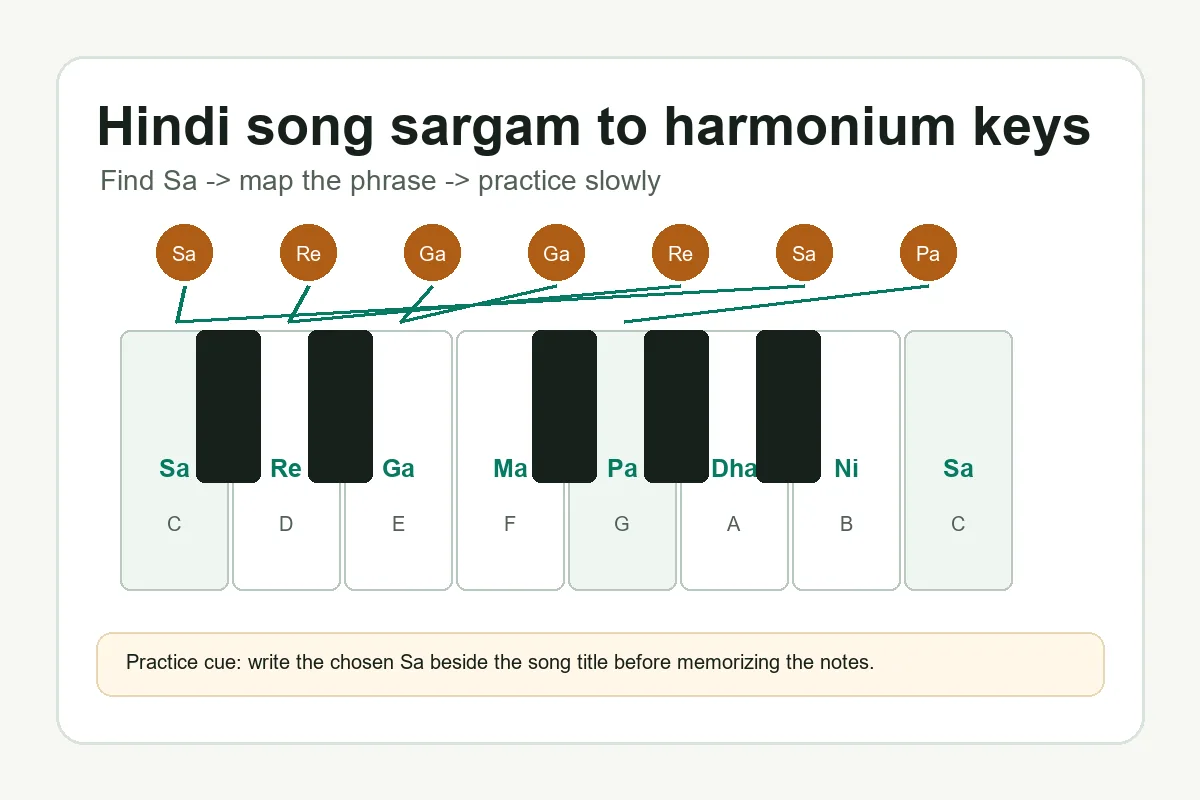
The example below is not a copyrighted song melody. It is a small practice phrase that behaves like many beginner Hindi song lines: it moves stepwise, returns to Sa, and uses Pa as a stable middle point. Use it to learn the mapping process before applying the same method to a real song from your teacher or notation source.
Assume C is Sa. The phrase Sa Re Ga, Ga Re Sa, Sa Ga Ma Pa can be played as C D E, E D C, C E F G. On the Web Harmonium keyboard, use the visible key labels on the instrument as your final check because computer-key layouts can differ between tools.
| Phrase piece | Sargam | If C is Sa | Practice focus |
|---|---|---|---|
| Opening rise | Sa Re Ga | C D E | Move evenly upward and do not rush Ga |
| Return | Ga Re Sa | E D C | Hear the phrase settle back on Sa |
| Small jump | Sa Ga Ma | C E F | Notice the skip from Sa to Ga |
| Landing | Ma Pa | F G | Let Pa sound stable before repeating |
Scope note: use short original drills for technique. For actual Hindi film songs or bhajans, follow a licensed book, teacher, or legitimate notation source and respect copyright restrictions.
Handle komal and tivra notes in Hindi song sargam
Many Hindi melodies sound wrong when beginners ignore altered notes. Komal usually means a lowered form of a note, and tivra most often refers to raised Ma. In practice, this often sends your finger to a black key when you are using a C-as-Sa beginner map, but the exact key still depends on the chosen Sa.
Mark altered notes before you play the whole line. If a phrase contains komal Ga or tivra Ma, circle it in your notes and practice only the two or three notes around it. The goal is to hear the color change instead of treating the black key as a random decoration.
Do not guess altered notes from song mood
Sad, devotional, romantic, and classical-influenced Hindi songs can all use different note sets. The emotion of the song does not tell you which key to press. Trust the notation, teacher, or scale explanation before adding komal or tivra notes.
If the notation source is unclear, compare two reliable sources or ask a teacher. Guessing may train your ear to accept a wrong version of the melody.
Practice the neighbor notes
When a phrase uses a changed note, isolate the movement into and out of that note. For example, practice Re-komal Ga-Re or Ma-tivra Ma-Pa slowly until the distance feels intentional.
A 15-minute routine for Hindi song harmonium notes
Song practice becomes easier when each session has a repeatable shape. Do not begin by playing the entire song from top to bottom. Start with the scale, then work on one phrase, then join two phrases, and only then add lyrics or rhythm.
Use the online harmonium keyboard for quick checks when you do not have a physical instrument nearby. Keep reverb low while learning the notes so wrong pitches are easy to hear.
-
1
Minutes 0-3: choose Sa and play the scale
Set the root for the song and play Sa Re Ga Ma Pa slowly. If the voice is strained, transpose before continuing.
-
2
Minutes 3-7: map one line
Write the sargam or western letters under the lyric line, then play only that line until every note is clear.
-
3
Minutes 7-10: repeat without looking
Look away from the chart for a few attempts. If you miss a note, return to the chart instead of guessing.
-
4
Minutes 10-13: add rhythm
Keep the same notes but place them closer to the song's rhythm. Avoid speeding up before the pitch is steady.
-
5
Minutes 13-15: sing or hum with the line
Hum the melody while playing softly. The harmonium should support the voice, not cover it.
How to judge a Hindi song notes source
Not every song-notes page explains its assumptions. Before saving a chart, check whether it names the scale, shows Sa, marks komal and tivra notes, and separates lyrics from notation. A clean source also tells you whether the notes are meant for harmonium, piano, flute, or a specific app.
If a source only lists long strings of notes, treat it as a starting clue, not the final authority. Compare the first line against a recording at low speed, then adjust your Sa and altered notes until the melody makes musical sense.
- Encyclopaedia Britannica: harmonium - background on the harmonium as a reed keyboard instrument.
- Encyclopaedia Britannica: raga - context for Indian melodic frameworks and tonal focus.
Hindi song harmonium notes FAQ
What is the easiest way to play Hindi song notes on harmonium?
Start with one short line. Find Sa, map each sargam note to a key, play slowly, then add rhythm and lyrics only after the note order is stable.
Can I use C as Sa for every Hindi song?
You can use C as Sa for learning a beginner map, but you should move Sa when singing if C does not fit your voice or the recording.
Are Hindi song sargam notes the same as western notes?
No. Sargam describes note roles relative to Sa, while western letters usually describe fixed pitches. They can be connected with a chart, but you must know the chosen Sa.
Why does a song sound wrong even when I play the written notes?
The source may use a different Sa, omit komal or tivra markings, or simplify the melody. Check the root, altered notes, rhythm, and phrase direction before memorizing it.
Can I practice harmonium key notes for Hindi songs online?
Yes. A browser harmonium is useful for checking note order, transposition, and short phrases. Use a physical harmonium when you need bellows control and performance touch.
Practice Hindi song notes on the online harmonium
Open Web Harmonium, choose a comfortable Sa, and test one short sargam phrase before you move to a full song.
Open the online harmonium