
Quick answer: what are the basic harmonium notes?
The basic harmonium notes are Sa, Re, Ga, Ma, Pa, Dha, and Ni. In western note names, a common beginner setup treats C as Sa, then D as Re, E as Ga, F as Ma, G as Pa, A as Dha, and B as Ni.
This C-to-Sa mapping is only a starting point. In Indian classical and devotional music, Sa is movable, so the same Sa Re Ga Ma pattern can begin from another key when a singer needs a different pitch.
For a beginner, the important point is not memorizing every possible scale on day one. It is learning one clean reference layout, hearing the distance between notes, and then understanding that the reference can move. That is why many teachers first use a simple C major style layout before introducing other roots.
On a harmonium keyboard, white keys and black keys are physical locations. Sa, Re, Ga, Ma, Pa, Dha, and Ni are musical roles inside a chosen scale. When you choose C as Sa, the white keys from C to B give you the easiest visual route through the basic shuddha notes.
Harmonium notes chart: Sa Re Ga Ma and C D E F G A B
Use this harmonium notes chart as a starter map. It is written for beginners who want to connect Indian note names with western keyboard labels. The chart assumes C is Sa because that layout uses the white keys in order and makes the first practice session less confusing.
Once this chart feels natural, you can move Sa to another key. The relationships stay the same, but the physical keys change. That movable system is one reason harmonium is useful for singers: the same phrase can be shifted to a comfortable vocal range.
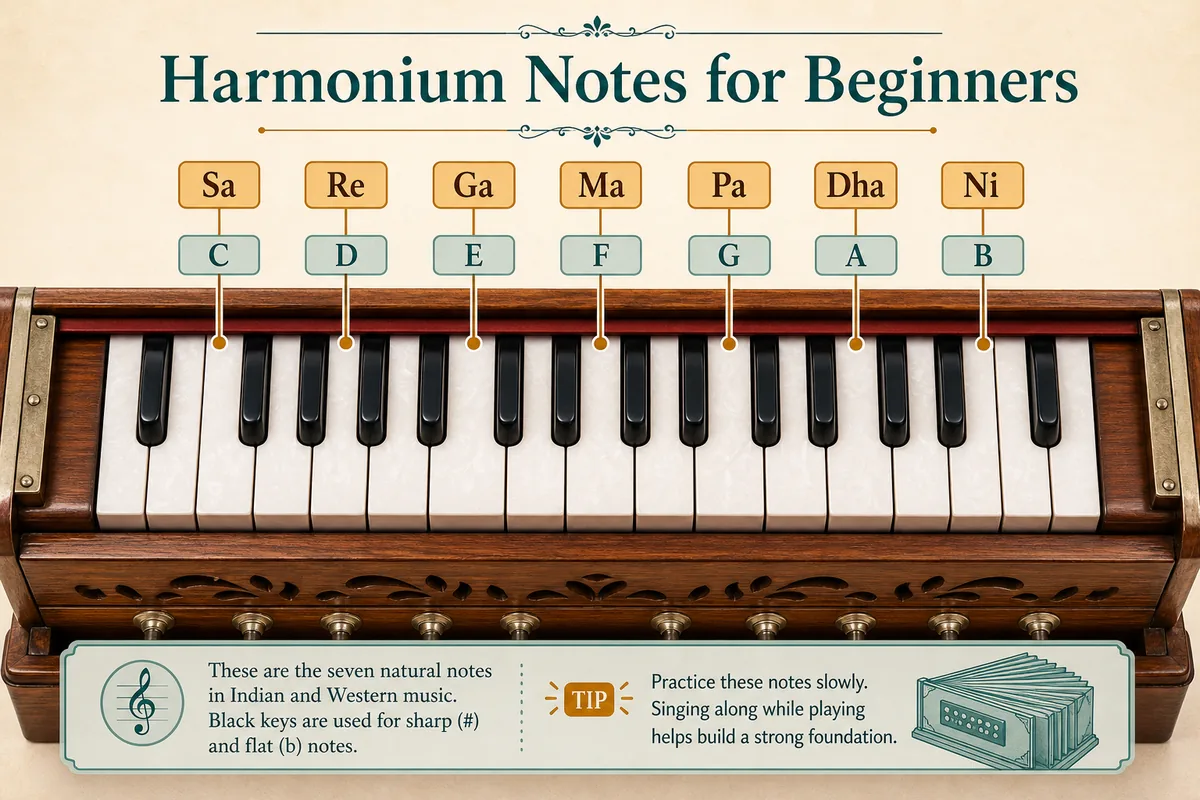
| Indian note | Western note when C is Sa | Basic role | Beginner practice cue |
|---|---|---|---|
| Sa | C | Root or home note | Start and end simple phrases here so your ear feels settled. |
| Re | D | Second note | Move from Sa to Re slowly and listen for a clear step upward. |
| Ga | E | Third note | Use Sa Re Ga to check whether your hand is moving evenly. |
| Ma | F | Fourth note | Pause here when practicing short call-and-response phrases. |
| Pa | G | Fifth note | Treat Pa as a strong reference point after Sa. |
| Dha | A | Sixth note | Practice Dha only after the lower five notes are steady. |
| Ni | B | Seventh note | Use Ni to lead back to upper Sa without rushing. |
| Upper Sa | C | Octave root | Return here to complete the scale cleanly. |
Fact: the western labels above describe one beginner-friendly mapping, not a permanent rule for all Indian music.
Practice advice: say the note name out loud while playing it. Speaking Sa Re Ga Ma while your finger moves helps connect sound, name, and keyboard location.
How to find Sa on a harmonium keyboard
Sa is the tonal center of the scale. In a fixed-pitch explanation, you may see Sa placed on C. In real singing practice, Sa should match the singer's comfortable pitch. A male singer, female singer, child, or group may each need a different Sa.
A practical beginner method is to start with C as Sa, sing or hum a relaxed note, and then shift the root only if the voice feels too low or too high. If the first note forces strain, the scale is not useful for practice even if the theory is correct.
Why Sa is movable
In western notation, C, D, E, and F usually point to fixed pitches. In sargam practice, Sa describes the home position of the raga or exercise. If you move Sa from C to D, then Re, Ga, Ma, Pa, Dha, and Ni move with it.
This is why a harmonium player can accompany different singers without changing the melody idea. The fingering and physical distance may shift, but the role of each note remains understandable once you hear the scale from the new Sa.
A safe beginner rule
Use C as Sa for reading charts and learning the keyboard shape. Use your voice to choose Sa for singing practice. If those two goals conflict, separate them: first study the chart slowly, then transpose the pattern to the singer's pitch.
Shuddha, Komal, and Tivra notes explained simply
The white-key chart is enough for your first harmonium notes practice, but real songs and ragas often use altered notes. In many beginner explanations, the natural notes are called shuddha, some lowered notes are called komal, and the raised fourth is called tivra Ma.
You do not need to master every variation before playing simple exercises. You do need to know why black keys appear in notation and why a phrase may not stay only on the white keys.
| Term | Simple meaning | Keyboard idea | Beginner caution |
|---|---|---|---|
| Shuddha | Natural form of a note | Often shown in the basic Sa Re Ga Ma pattern | Start here before adding altered notes. |
| Komal | Lowered form of a note | Usually one key lower than the shuddha form | Do not guess by name alone; check the scale being taught. |
| Tivra | Raised form, mainly used for Ma | Usually one key higher than shuddha Ma | Tivra Ma changes the color of the phrase strongly. |
Scope note: naming systems can vary by teaching tradition and notation style. When learning a specific raga or song, follow the exact notation from your teacher or source.
- Encyclopaedia Britannica: harmonium - background on the harmonium as a keyboard instrument with reeds and bellows.
- Encyclopaedia Britannica: raga - context for how Indian melodic practice uses scale material and tonal focus.
Beginner keyboard map for practicing harmonium notes online
If you are practicing on a computer, a keyboard map helps you repeat notes without using a mouse for every sound. The goal is not to turn typing into performance technique. The goal is to hear the notes, remember their order, and build confidence before moving to a physical instrument.
On Web Harmonium, the visible keyboard labels place the center C area around the E key on a QWERTY keyboard. That means you can use nearby keys for a simple white-key scale when C is Sa. Keep the tempo slow enough that each note sounds intentional.
| Computer key | Displayed western note area | Sargam role when C is Sa | How to practice |
|---|---|---|---|
| e | C | Sa | Play and hold briefly before moving. |
| r | D | Re | Move up from Sa, then return to Sa. |
| t | E | Ga | Practice Sa Re Ga, then reverse. |
| y | F | Ma | Use as the turning point in four-note drills. |
| u | G | Pa | Treat as a strong checkpoint after Sa. |
| i | A | Dha | Add only when the first five notes are stable. |
| o | B | Ni | Lead gently toward upper Sa. |
| p | Upper C | Upper Sa | Finish the octave, then descend slowly. |
Check harmonium notes online with laptop keys
If you do not have a physical instrument yet, the online harmonium keyboard can make the note order audible. Use it first as a pitch reference: play Sa Re Ga Ma slowly, name each note, and only then adjust transpose or reverb.
Computer keys are only a control method. For your music notes, the important label is still the note or sargam role. Write Sa, Re, Ga or C, D, E, not the QWERTY key that triggered the sound. If the letters confuse you, use the harmonium with English keys guide before returning to this chart.
| Online drill | Why it helps | Limit |
|---|---|---|
| Hear Sa Re Ga Ma | Your ear connects note names to sound faster. | Bellows and touch still require a physical harmonium. |
| Test transpose | You hear the same relationship in another pitch range. | The chosen Sa must be written clearly. |
| Repeat with laptop keys | Short patterns are easy to repeat quickly. | Shortcut letters are not music notation. |
Common mistakes when reading harmonium notes
The most common mistake is treating Sa as if it must always be C. C as Sa is a helpful beginner map, but singers often need another root. If a song tutorial says Sa is D, then the whole pattern begins from D, not C.
Another mistake is rushing through the chart without listening. Harmonium notes are not only labels. They are sounds with distance and direction. A slow Sa Re Ga Ma played cleanly teaches more than a fast scale played with uncertain fingers.
Beginners also mix up black keys because they memorize key color instead of note role. A black key can be correct in one scale and wrong in another. Always ask: what is Sa, and what version of Re, Ga, Ma, Dha, or Ni does this exercise require?
Do not skip descending practice
Many learners can climb Sa Re Ga Ma Pa but become uncertain when descending Pa Ma Ga Re Sa. Practice both directions from the first day. Descending slowly improves pitch memory and makes song phrases easier to follow.
Do not hide mistakes with heavy effects
A clean tone makes wrong notes easier to hear. If you use a digital or browser-based harmonium, keep reverb low while learning notes. Add richer tone later when your pitch and rhythm are steadier.
Practice routine: 10 minutes a day
A short daily routine works better than a long session you repeat once and forget. The routine below is designed for harmonium notes for beginners: it keeps the keyboard area small, repeats the same note names, and gives your ear time to adjust.
Use a moderate volume and avoid playing faster than you can name the notes. If you lose track, stop on Sa, breathe, and begin again. Accuracy matters more than speed.
-
1
Minute 1: find Sa
Play C as Sa for chart practice, or choose another comfortable root if you are singing. Hold the note long enough to hear it settle.
-
2
Minutes 2-3: play four notes
Repeat Sa Re Ga Ma, then Ma Ga Re Sa. Keep every note even and say the names aloud.
-
3
Minutes 4-5: add Pa
Practice Sa Re Ga Ma Pa, then Pa Ma Ga Re Sa. Pause on Pa so it becomes a second reference point.
-
4
Minutes 6-7: complete the octave
Play Sa Re Ga Ma Pa Dha Ni Sa slowly. Descend immediately so the return path becomes familiar.
-
5
Minutes 8-9: make short phrases
Try tiny patterns such as Sa Re Ga, Ga Re Sa, Sa Ma Ga Re, and Pa Ma Ga Re. Keep them simple.
-
6
Minute 10: review without looking
Look away for a few notes and test whether your ear and hand remember the order. Then check the chart again.
When a harmonium notes query is really a song-notes query
Similarweb keyword data shows strong demand for web harmonium notes, but many related terms are specific songs such as Happy Birthday or individual Hindi film lines. Those should not be forced into a beginner notes chart because the user expects a playable melody, lyrics, or phrase-by-phrase notation.
Use this page for the foundation: Sa, Re, Ga, Ma, western note labels, movable Sa, black keys, and a slow practice routine. When the query names a song, move to a song-notes workflow: identify Sa, check the notation style, play one short phrase, and compare it with the recording.
| Query type | Best page fit | What to do |
|---|---|---|
| harmonium notes / harmonium notes chart | This beginner guide | Learn the note names, keyboard map, and movable Sa. |
| web harmonium notes for songs | Song-note guide | Use the existing song notes article for phrase mapping and notation checks. |
| specific song harmonium notes | Future song page, not this page | Create a separate page only in a future workflow if the song intent is strong and distinct. |
What to learn after the first notes
After the basic harmonium notes chart feels comfortable, move in three directions: learn one simple song line, learn how your teacher marks komal and tivra notes, and practice shifting Sa to match a singer. These skills make the chart useful in real music instead of leaving it as theory.
For bhajan or raga study, do not assume every tutorial uses the same notation style. Some sources write western note names, some write sargam, and some combine lyrics with note syllables. Before practicing, identify the root, the note set, and whether the phrase is ascending, descending, or repeating around a small group of notes.
A digital practice tool can help you check note order quickly, but a physical harmonium still teaches bellows control, touch, and acoustic response. Treat online practice as a convenient note reference and use a real instrument whenever expression and accompaniment matter.
When you want to turn a written phrase into western pitches and computer keys, use the harmonium notes generator. It is best for short Sargam exercises after you understand how movable Sa works.
Harmonium notes FAQ
What are the basic harmonium notes for beginners?
The basic harmonium notes are Sa, Re, Ga, Ma, Pa, Dha, and Ni. If C is used as Sa, the simple beginner chart is C Sa, D Re, E Ga, F Ma, G Pa, A Dha, and B Ni.
Is Sa always C on harmonium?
No. C as Sa is a beginner-friendly reference, but Sa is movable in Indian music practice. A singer may choose C, D, E, F, or another pitch as Sa depending on vocal comfort.
How do I read a harmonium notes chart?
First find the chosen Sa, then read the other notes by their relationship to Sa. If the chart uses western notes, check whether it assumes C as Sa or another root before playing.
What is the difference between shuddha, komal, and tivra notes?
Shuddha means the natural form of a note, komal usually means a lowered form, and tivra refers to a raised form, most commonly tivra Ma. The exact key depends on the selected Sa and the scale being practiced.
Can I practice harmonium keyboard notes without a physical harmonium?
Yes. You can use a browser-based harmonium to learn note order, hear Sa Re Ga Ma, and repeat simple exercises. A physical harmonium is still better for bellows technique and performance expression.
What should I practice first: notes, songs, or ragas?
Start with notes and very short phrases. Once Sa Re Ga Ma Pa feels steady in both directions, learn a simple song line or beginner raga exercise from a teacher or reliable notation source.
Can I learn harmonium notes online?
Yes. An online harmonium helps you hear Sa Re Ga Ma, repeat short patterns, and test transpose. A physical harmonium is still needed for bellows control, touch, and expression.
Should specific song harmonium notes be added to this beginner chart?
No. A beginner chart should teach Sa Re Ga Ma, western labels, and movable Sa. Specific song notes need their own phrase-by-phrase context, so they are better handled in a song-notes guide or a future dedicated song page.
Practice the chart on a harmonium keyboard
Use the Web Harmonium keyboard to play the C-as-Sa chart, then try the 10-minute routine while the note names are fresh.
Open the online harmonium