
Quick answer: what does harmonium with English keys mean?
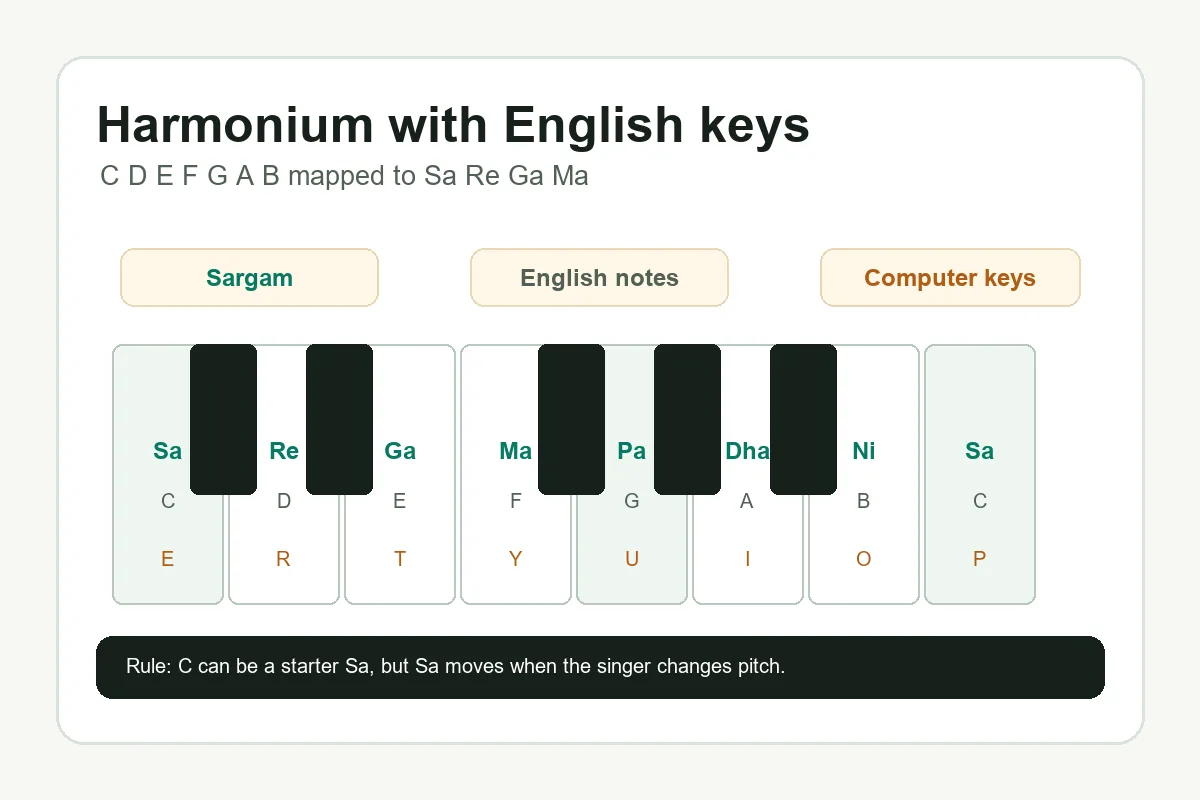
Harmonium with English keys usually means the lesson writes notes as C, D, E, F, G, A, and B instead of only Sa, Re, Ga, Ma, Pa, Dha, and Ni. A common beginner map treats C as Sa, D as Re, E as Ga, F as Ma, G as Pa, A as Dha, and B as Ni.
That map is useful for reading a keyboard, but it is not a rule that Sa must always be C. In Indian music, Sa is movable. If a singer chooses D as Sa, every sargam note moves with that new center.
Many beginners search for harmonium with English keys because a song page, video lesson, or online tool shows letters instead of sargam. The confusion starts when those letters are mixed with computer keyboard labels. On Web Harmonium, the visible instrument may show western note names and QWERTY shortcuts, while a music teacher may still speak in Sa Re Ga Ma.
Use this page as the missing bridge between the harmonium notes for beginners chart, the first playing routine, and song-note practice. The goal is simple: know which system you are reading before you press a key.
Starter chart: C D E F G A B as Sa Re Ga Ma Pa Dha Ni
For a first lesson, C as Sa is the easiest visual map because the basic shuddha notes sit on the white keys. This does not make C more important than other roots. It simply gives beginners a clean way to see the order of notes before transposition becomes important.
When you read English harmonium notes, ask whether the letters mean fixed western pitch names or a C-as-Sa teaching map. If the page says C D E, it may mean exactly those notes. If the page says Sa Re Ga and then gives C D E as help, it is probably showing the starter map below.
| Sargam | English key if C is Sa | Role in practice | Beginner warning |
|---|---|---|---|
| Sa | C | Home note and resting point | Do not assume every song uses C as Sa. |
| Re | D | First step above Sa | Keep it relative to the chosen Sa. |
| Ga | E | Third note in the starter map | Check whether the song needs komal Ga. |
| Ma | F | Middle reference before Pa | Tivra Ma changes the key choice. |
| Pa | G | Stable support note | Useful for checking pitch direction. |
| Dha | A | Upper movement toward Ni | Do not rush past it in descending lines. |
| Ni | B | Leading note back to upper Sa | May be komal in some scales or songs. |
Why English keys are fixed but Sa can move
English note names label fixed keyboard positions. C is C whether you are playing harmonium, piano, or an online keyboard. Sargam names describe musical relationships. Sa is the center, Re is the next step, Pa is a stable fifth, and the rest of the scale is heard from that chosen center.
This is why the same written sargam line can be played in different English keys. If a singer chooses C as Sa, Sa Re Ga becomes C D E. If the singer chooses D as Sa, the same relationship becomes D E F sharp in a major-style starter scale. The sargam names stayed the same, but the English keys changed.
| Chosen Sa | Sa Re Ga Ma Pa in English keys | When to use it |
|---|---|---|
| C as Sa | C D E F G | Good for first keyboard maps and simple white-key practice. |
| D as Sa | D E F# G A | Useful when C feels too low for the singer. |
| E as Sa | E F# G# A B | Useful for higher voices or some lesson recordings. |
| F as Sa | F G A Bb C | A comfortable middle option for many singers. |
Practical rule: if a note page gives only Sa Re Ga Ma, write the chosen Sa before translating anything into English letters.
If a page gives only English letters, treat those letters as fixed keys unless the source clearly says they are only an example map.
How black keys appear in English harmonium notes
A beginner chart often starts with white keys, but real melodies can use black keys. In English notation, black keys are usually written with sharps or flats: C sharp, D sharp, F sharp, G sharp, A sharp, or their flat-name equivalents such as D flat and E flat. In sargam, you may see words such as komal Re, komal Ga, komal Dha, komal Ni, or tivra Ma.
Do not add black keys by guessing from the mood of a song. Mark the altered note first, then practice only the two or three notes around it. If the phrase says Re komal Ga Re, your finger should learn that small movement before you try the whole line.
| Sargam wording | Common English-key idea when C is Sa | What to check |
|---|---|---|
| Komal Re | Db / C# | Lowered Re, often a black key in the starter map. |
| Komal Ga | Eb / D# | Lowered Ga, common in many melodic colors. |
| Tivra Ma | F# | Raised Ma, not the same as normal Ma. |
| Komal Dha | Ab / G# | Lowered Dha, check the scale or teacher note. |
| Komal Ni | Bb / A# | Lowered Ni, often changes the pull back to Sa. |
Do not confuse English notes with computer keyboard labels
Online harmonium tools often let you play with computer keys. Those letters are shortcuts, not musical note names. A QWERTY key such as e or r may trigger a visible harmonium key, but that does not mean the music note is called E or R. It only means your computer key activates that sound on this specific layout.
This matters when you copy notes from one website to another. A song written as C D E can move between instruments because C, D, and E are musical note names. A song written as e r t may only work on the website that created that QWERTY layout. Always check the tool's own keyboard map before memorizing computer-key sequences.
-
1
Identify the notation type
Look for clues: Sa Re Ga means sargam, C D E means English note names, and q w e or e r t usually means computer keys.
-
2
Find the visible note label
On a web harmonium, press the shortcut slowly and watch which musical key lights up or sounds.
-
3
Translate once
Write the line in one system before practicing. Mixing three systems in one line causes mistakes.
-
4
Keep a source note
Mark whether your chart came from a teacher, a book, a video, or a specific web keyboard layout.
How to practice English-key notes on a laptop harmonium
A laptop harmonium layout gives you two different letter systems at once: the musical letters C D E F G A B and the physical QWERTY keys you press. Keep them separate. Say the musical note or sargam role aloud, then use the computer shortcut only as a control.
For quick drills on Web Harmonium, start around the visible C area and repeat one short pattern before moving Sa. This helps laptop harmonium online practice without turning QWERTY labels into fake music notation.
| Practice goal | Use these labels | Avoid this mistake |
|---|---|---|
| Learn English notes | C D E F G A B | Do not write q w e as if they were music notes. |
| Learn sargam roles | Sa Re Ga Ma Pa | Do not assume Sa is always C after you transpose. |
| Use laptop shortcuts | e r t y u near the visible C area | Do not copy shortcut letters to a different site without checking its map. |
How to read song notes written with English keys
When a song page gives English harmonium keys, first decide whether the letters are meant for a fixed recording key or a beginner-friendly version. A fixed recording key may not fit your voice. A beginner version may use C as Sa so the first phrase is easier to see, even if the original song uses another pitch.
For learning, work phrase by phrase. Read the first three to five notes, play them slowly, then sing or hum the same line. If the melody feels too high or too low, transpose the whole pattern instead of changing one note at a time. This keeps the relationships intact.
| What the source shows | Likely meaning | Best next action |
|---|---|---|
| C D E F G | Fixed English note names or C-as-Sa map | Check whether the page mentions Sa or transposition. |
| Sa Re Ga Ma Pa | Sargam relative to a chosen Sa | Choose Sa before converting to English keys. |
| e r t y u | Computer shortcuts for one online tool | Open that tool's map before copying. |
| C# or Bb | Black-key movement | Mark the altered note and practice nearby notes slowly. |
- Encyclopaedia Britannica: harmonium - background on the harmonium as a reed keyboard instrument.
- MDN Web Docs: KeyboardEvent key values - browser reference for physical keyboard labels used by web tools.
A 12-minute practice routine for English-key harmonium notes
A short routine is enough to make English-key notes less confusing. The point is not to memorize every possible scale in one sitting. The point is to connect one visible key, one sargam role, and one sound in your ear.
Use the online harmonium keyboard with low reverb so the note edge is clear. If you have a physical harmonium, repeat the same routine there and listen for steady bellows pressure.
-
1
Minutes 0-2: name the white keys
Play C D E F G A B slowly and say the English names aloud.
-
2
Minutes 2-5: map C as Sa
Play C D E F G as Sa Re Ga Ma Pa, then return Pa Ma Ga Re Sa.
-
3
Minutes 5-8: move Sa
Choose D as Sa and notice how the English letters change while the sargam roles remain stable.
-
4
Minutes 8-10: add one black key
Practice normal Ma and tivra Ma as F and F# when C is Sa.
-
5
Minutes 10-12: read one phrase
Translate one short line into a single system and repeat it without switching labels.
Harmonium with English keys FAQ
Is C always Sa on harmonium?
No. C is often used as a beginner Sa because it makes the starter map easy to see, but Sa can move to any comfortable pitch.
Are English harmonium keys the same as piano notes?
The note names C D E F G A B are the same keyboard pitch labels, but harmonium playing often uses sargam relationships and movable Sa.
What is the difference between C D E and e r t on a web harmonium?
C D E are musical note names. e r t are computer keyboard shortcuts for a specific website layout.
How do I convert Sa Re Ga Ma to English keys?
Choose Sa first. If C is Sa, Sa Re Ga Ma becomes C D E F. If D is Sa, the English keys change with the scale.
Can I use English keys for Hindi song notes?
Yes, but check whether the source uses fixed English notes, sargam, or web keyboard shortcuts. Convert the whole phrase consistently before practicing.
Can I practice harmonium English keys on a laptop keyboard?
Yes. Use the online harmonium keyboard for quick C D E and Sa Re Ga Ma drills, but remember that QWERTY letters are shortcuts. The musical note is the visible C, D, E, or sargam role, not the computer key itself.
Try the English-key map on the online harmonium
Open Web Harmonium, play C D E as Sa Re Ga, then move Sa and hear how the English keys change.
Open the online harmonium