
Quick answer: why is harmonium used in Indian classical music?
Harmonium is used in Indian classical music because it gives singers a steady pitch reference, a visible keyboard map, and a sustained reed tone that can follow raga phrases during lessons and rehearsal.
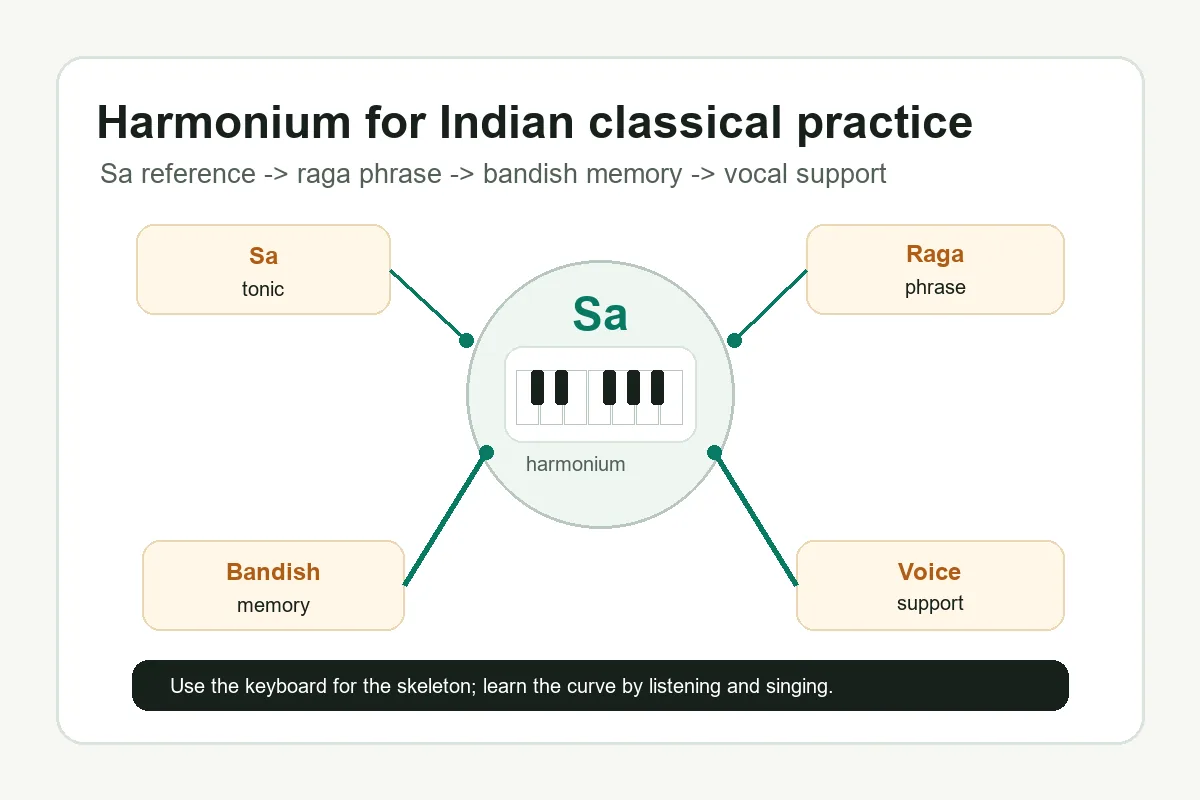
Its strongest role is accompaniment and practice support: setting Sa, checking sargam, rehearsing a bandish, and helping students hear whether a phrase rises, falls, pauses, or resolves.
A harmonium is a free-reed keyboard instrument, so the player pumps air and presses keys to sound notes. In Hindustani and devotional settings it became practical because it is portable, loud enough for a lesson room, easier to keep stable than many melodic instruments, and simple for teachers to use while singing.
The important boundary is musical: Indian classical music depends on raga grammar, intonation, ornament, breath, and listening. A harmonium can show the note path, but it should not become a mechanical substitute for voice training or for hearing a raga from experienced performers. Use it as a clear reference, then keep listening beyond the keyboard.
Core roles of harmonium in raga and vocal practice
Most beginners first meet the harmonium as an accompaniment instrument. The teacher or accompanist follows the vocalist, reinforces the melodic line, and gives a stable home note when the ear starts to drift. In a lesson, this support can make abstract raga movement easier to understand.
The harmonium also helps with practical memory. A student can mark which key is Sa, repeat an aroha or avaroha slowly, and connect the bandish text to its pitch movement. This is not the whole raga, but it is a useful map before deeper listening and correction.
| Practice role | How harmonium helps | What to avoid |
|---|---|---|
| Sa reference | Keeps the tonic available while the singer warms up or starts a phrase. | Do not keep changing Sa during one session unless the teacher asks. |
| Raga phrase support | Shows whether the phrase moves stepwise, leaps, pauses, or returns. | Do not flatten every ornament into plain keyboard steps. |
| Bandish rehearsal | Connects lyrics, sthayi/antara sections, and note direction. | Do not memorize keys without understanding the melodic grammar. |
| Vocal accompaniment | Follows the singer and fills small gaps between lines. | Do not overpower the voice or anticipate every improvisation. |
| Student self-check | Lets learners test short phrases between lessons. | Do not treat online or keyboard practice as a replacement for feedback. |
How to use harmonium for raga practice without making it mechanical
Start with the raga idea, not with random keys. Identify Sa, listen to the raga from a reliable teacher or recording, then use the harmonium only to test the small phrase you are practicing. The best use is slow and selective: one phrase, one correction, one repetition.
For alankars and sargam drills, the harmonium can keep your pitch center steady. For raga phrases, it should be lighter. Sing first when possible, then check the phrase on the keys. If the key version feels too square, return to listening and singing before adding speed.
-
1
Set Sa and stay with it
Choose the tonic for the voice or lesson. Mark it mentally before playing any pattern.
-
2
Sing before playing
Try the phrase with your voice first so the harmonium checks the ear instead of replacing it.
-
3
Play only the phrase you need
Use two to six notes at a time. Long wandering keyboard runs usually hide the raga problem.
-
4
Return to the vocal line
After checking the notes, sing again with attention to glide, stress, and resolution.
What harmonium can and cannot teach in raga practice
Use harmonium to stabilize Sa, remember a bandish, compare phrase direction, and support vocal rehearsal. Do not treat equal-tempered keys as the complete sound of a raga.
For a beginner lesson, the keyboard is most useful as a map: play Sa, sing the phrase without keys, then return only to check the landing note. This keeps listening at the center of practice.
A practical sequence is Sa reference, slow aroha-avaroha, one pakad, one line of bandish, and finally the same line without harmonium. Learn meend, andolan, and delicate shruti from a teacher or reliable performance rather than forcing every contour into separate keys.
Where harmonium is limited in Indian classical music
The main limitation is that a standard harmonium has fixed keyboard pitches. Many raga phrases rely on meend, andolan, kan swar, microtonal shades, and a living sense of intonation that cannot be fully drawn on equal-spaced keys. This does not make the harmonium useless; it means the player must understand what the instrument is simplifying.
A second limitation is expression. A physical harmonium can shape air and sustain, but it still cannot reproduce vocal breath, vowel color, or the curved movement of a singer. An online harmonium is even more limited: it is excellent for pitch checking and keyboard memory, but it cannot teach bellows pressure or subtle accompaniment touch.
Practical rule: use harmonium to confirm the skeleton of the phrase, then use listening and vocal practice to learn the curve of the phrase.
If your teacher gives a version that differs from a keyboard map, follow the teacher and the raga context rather than forcing the map.
How harmonium accompaniment should support the vocalist
Good accompaniment is responsive. The harmonium player listens to the singer, gives a clear pitch bed, echoes important phrases when helpful, and leaves room for breath, tabla, and silence. The goal is not to show every possible run; the goal is to help the vocalist stay confident inside the raga.
During alap, the harmonium may be sparse because the singer needs space for slow development. During a bandish, it can reinforce the melodic line and return points. During faster taan practice, it may mark the main path rather than every detail. The accompanist must know when less playing is more useful.
| Moment | Helpful harmonium behavior | Common mistake |
|---|---|---|
| Alap | Hold Sa, respond gently, and avoid crowding slow phrases. | Playing too many fixed notes over curved vocal movement. |
| Bandish | Support the composition and return clearly to sam. | Covering the lyrics with heavy chords or loud reeds. |
| Sargam | Show the sequence cleanly at a slow tempo. | Rushing before the note order is stable. |
| Taan practice | Mark the main contour and let the singer lead. | Trying to duplicate every vocal detail mechanically. |
How online harmonium fits Indian classical practice
A browser-based online harmonium is useful for short checks: finding Sa, repeating a sargam pattern, testing whether a phrase moves to Pa or Ma, and reviewing lesson notes when the physical instrument is not nearby. It lowers friction, which matters for daily repetition.
Use the online keyboard as a notebook for sound, not as the final authority. For the first layer of study, pair it with the harmonium notes for beginners guide. For first-session hand use, follow how to play harmonium. For general instrument background, read the harmonium instrument guide.
-
1
Open with one purpose
Decide whether you are checking Sa, a scale, a bandish line, or a difficult transition.
-
2
Keep sessions short
Five focused minutes usually teaches more than twenty minutes of unfocused key pressing.
-
3
Write the chosen Sa
Keep a note beside the song or raga name so the next practice starts consistently.
-
4
Verify with singing
After keyboard checking, sing the same line without looking at the keys.
Reliable source checks for harmonium and raga context
Because Indian classical music is learned through listening and teaching, a page can only give a framework. Use authoritative references for instrument mechanics, then rely on a qualified teacher or tradition-specific source for raga grammar, bandish style, and ornament.
The sources below support the instrument and raga background used in this guide. They do not replace lineage-specific instruction, but they help separate basic facts from casual internet shortcuts.
- Encyclopaedia Britannica: harmonium - background on the harmonium as a free-reed keyboard instrument.
- Encyclopaedia Britannica: free-reed instrument - explains the reed family behind harmoniums and related instruments.
- Kennedy Center: Rhythm and Raga - introductory explanation of raga as a core idea in Indian classical music.
Harmonium in Indian classical music FAQ
Is harmonium accepted in Indian classical music?
Yes, especially as a vocal accompaniment and teaching instrument. It is also debated because fixed keys cannot fully express every raga ornament, so it should be used with awareness of its limits.
Can I learn raga on harmonium?
You can use harmonium to learn Sa, sargam, phrase direction, and bandish memory. To learn raga deeply, you still need listening, singing, correction, and attention to ornament and intonation.
Is harmonium better than keyboard for Indian classical music?
For traditional vocal support, harmonium tone and sustain usually feel more appropriate than a generic electronic keyboard. A keyboard may offer tuning and recording options, but it does not automatically teach raga phrasing.
Can online harmonium help Indian classical practice?
Yes. It is useful for quick pitch checks, Sa reference, and short phrase repetition. It cannot replace a physical harmonium for bellows control or a teacher for raga correction.
Why do some musicians criticize harmonium for raga?
The criticism usually concerns fixed pitch and limited ability to show meend, shruti nuance, and curved vocal ornaments. Those concerns are real, but careful players still use harmonium effectively as a support instrument.
Can harmonium be used to learn raga without vocal training?
It can help you identify notes and remember basic phrase shapes, but raga learning also depends on listening, intonation, ornament, rhythm, and style. Use harmonium as a reference and combine it with guided singing or close listening to experienced performers.
Practice Sa and raga phrases in the browser
Open Web Harmonium when you need a quick pitch reference, a short sargam check, or a simple way to review a raga phrase between lessons.
Open the online harmonium