
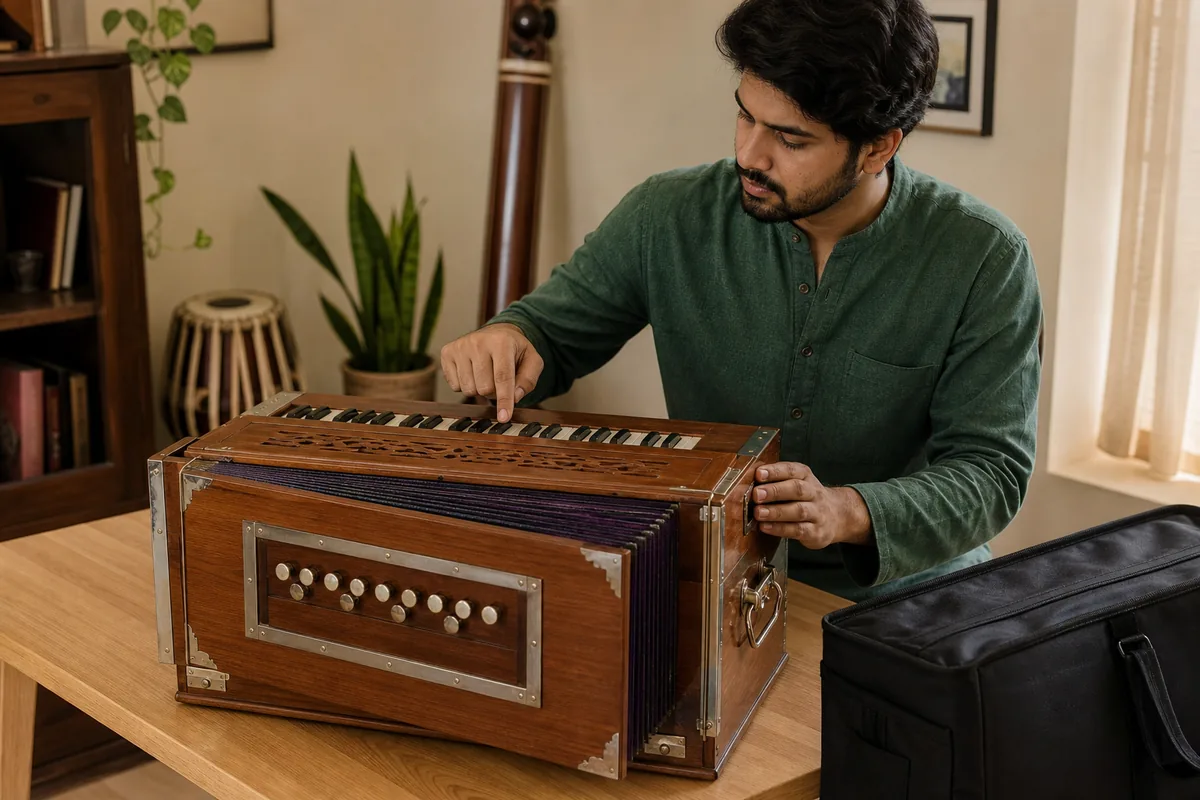
Quick answer: which harmonium is best for a beginner?
For a first physical instrument, look for a standard or folding hand-pumped Indian harmonium with about 3 to 3.25 octaves, one or two responsive reed banks, smooth keys, airtight bellows, and a simple layout. A double-reed model can provide a fuller sound, but a clean single-reed instrument is better than a poorly tuned double- or triple-reed model.
A scale changer is usually optional for a beginner. It can help accompanists move a familiar fingering pattern to another pitch, but it also adds weight, cost, and mechanical parts. Buy it only if a teacher or regular accompaniment work gives you a clear reason.
Do not choose the best harmonium from a specification list alone. Harmoniums are acoustic instruments, and two units with the same advertised reed count can differ in tuning, air leakage, keyboard noise, and response. Ask to hear the exact instrument, not only a demonstration of the same model.
Separate this choice from price research. The harmonium price guide explains budget bands, shipping, and repair cost. This page focuses on fit: which construction and controls help your actual practice. If you have never used the layout, try the online harmonium keyboard and read the beginner harmonium notes guide before paying for features you may not need.
Best harmonium choice by beginner use case
Your use case should decide the instrument before brand, finish, or knob count. Home learners can prioritize stable tone and durability. Travellers need a folding case and manageable weight. Singers need an easy Sa reference and steady air control. A student who accompanies different voices may eventually benefit from a scale changer, but a first-term learner usually gains more from reliable tuning and daily practice.
Use this matrix as a shortlist, then test the individual instrument. It describes useful starting points, not rigid rules.
| Main use | Beginner-friendly starting point | Feature to question |
|---|---|---|
| Home lessons and daily practice | Standard 3 to 3.25 octave model with smooth keys and stable tuning | Decorative extras that do not improve tone or action |
| Bhajan or kirtan singing | Responsive bellows, clear middle register, practical stops or drones | Too many reed banks that add weight and tuning work |
| Vocal pitch and raga practice | Even reeds, quiet key action, reliable Sa reference | Scale changer unless regular transposition is genuinely needed |
| Travel, classes, or small storage | Folding or suitcase harmonium with strong latches and padded bag | Very compact body if it weakens air capacity or serviceability |
| Accompanying different singers | Good tuning and key action first; scale changer only after teacher guidance | Buying the mechanism before learning why and how to use it |
Features that matter when choosing the best harmonium
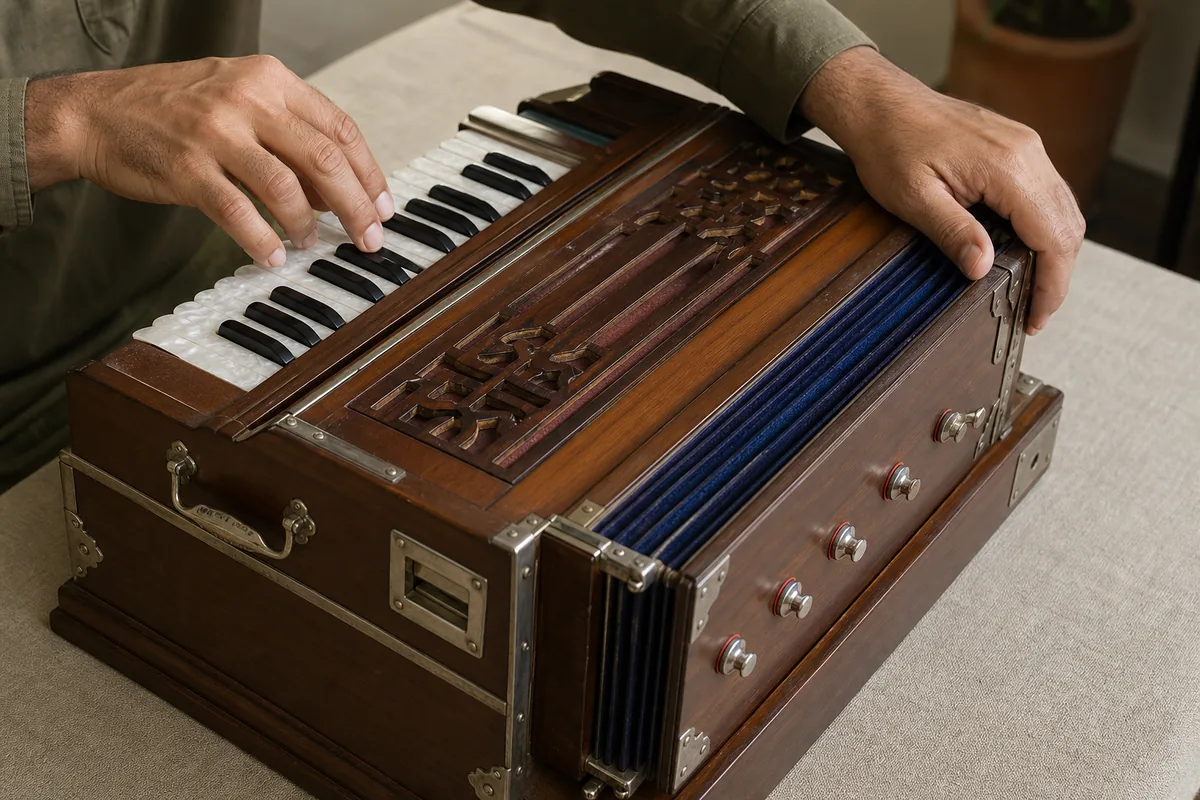
Reed count is one of the most advertised specifications. Single-reed harmoniums are lighter and simpler. Double-reed models can combine registers for a fuller tone. Triple-reed instruments may sound richer, but they are heavier and require more reeds to stay balanced. Beginners should judge clarity and response before quantity.
Bellows are the air supply. They should move without scraping, hold pressure without an obvious leak, and let a note start without frantic pumping. The keyboard should feel even from one end to the other. Sticky keys, loud clicks, delayed notes, and a large change in volume between neighbouring keys are warning signs.
Stops control airflow to reed banks, while drones sustain fixed notes. A coupler can make one key engage another octave and create a larger sound. These controls can be useful, but they do not rescue weak reeds or poor bellows. A clear basic voice is the priority.
| Feature | What it changes | Beginner recommendation |
|---|---|---|
| Octave range | Available low and high notes | About 3 to 3.25 octaves is a practical starting range |
| Reed banks | Tone colour, fullness, weight, and tuning workload | Choose clean response first; one or two banks are often enough |
| Bellows | Air stability and phrase control | Reject obvious leaks, scraping, or uneven resistance |
| Coupler | Adds an octave voice to a played key | Useful for fullness, optional for first practice |
| Scale changer | Moves the keyboard mechanism to transpose fingering | Buy only for a known accompaniment need |
| Folding case | Portability and storage | Check hinges, latches, alignment, and air seals carefully |
| Stops and drones | Select reed banks or fixed support tones | Test every control; do not buy by knob count |
A five-step harmonium test before you buy
When buying in a shop, perform the test yourself at a moderate bellows pressure. When buying remotely, request one continuous video of the exact unit. A polished product photo cannot show tuning drift, air leakage, delayed reeds, or noisy keys.
Use headphones for a remote video if possible, but remember that phone microphones change tone. The goal is not to judge concert sound from a clip; it is to find obvious inconsistency and confirm that the seller will answer specific questions.
-
1
Listen to every key slowly
Play chromatically from the lowest to highest key. Note silence, buzz, delayed speech, sudden volume changes, and notes that beat badly against the rest.
-
2
Hold a middle note
Keep steady bellows pressure and listen for a stable tone. Rapid fading can indicate an air leak or weak pressure control.
-
3
Open each stop separately
Confirm which reed bank or drone it controls. A loose or ineffective stop should be explained before purchase.
-
4
Check action and casework
Keys should return cleanly. Inspect bellows cloth, corners, hinges, latches, handles, and folding alignment.
-
5
Confirm tuning and service
Ask the tuning reference, who prepared the instrument, what the return period covers, and where future reed or bellows work can be done.
Shop, specialist seller, marketplace, or used harmonium?
A local specialist shop offers the strongest chance to play several units and return for service. A remote specialist can still be a good choice when it supplies an exact-unit video, careful packing, clear return terms, and repair support. General marketplaces offer more listings, but model names and specifications may be inconsistent. Used instruments can be excellent if a knowledgeable player or technician checks them.
Avoid a brand ranking that ignores the individual instrument. Maker reputation can help you create a shortlist, but tuning preparation, storage, shipping, and seller support influence the unit you receive. Ask whether the pictured harmonium is the one being shipped and whether it will be checked immediately before dispatch.
The sources below explain construction and buyer considerations. They are educational references, not endorsements of a seller or a promise that a current product is suitable.
- India Instruments harmonium purchase guide - overview of reed sets, registers, range, couplers, and scale changers.
- Bina harmonium instruction manual - first-party explanation of portable harmoniums and scale-changing construction.
- National Music India buying guide - specialist discussion of portable and standard harmonium trade-offs.
Common mistakes when buying a beginner harmonium
The first mistake is treating more features as better value. A scale changer, coupler, triple reeds, many drones, and ornate woodwork can all be legitimate, but each adds cost or complexity. A beginner who practices one melody line needs consistency more than maximum specification.
The second mistake is comparing sticker prices without shipping, tax, return cost, tuning after transit, and local repair access. The third is accepting a generic model demonstration instead of hearing the exact unit. Finally, do not assume online practice replaces the physical technique. A browser tool helps with notes and pitch direction, but only a real harmonium teaches bellows resistance, air timing, reed response, and posture.
Write down your main use, storage limit, transport needs, teacher's advice, total budget, and service options. Then choose the simplest instrument that passes the sound and condition test. That is a more dependable definition of the best harmonium than a universal top-ten list.
Best first priority: even tuning, airtight bellows, smooth keys, and reachable service.
Best feature rule: pay for a feature only when you can describe how it supports your regular practice.
Best harmonium for beginners FAQ
Is a single-reed or double-reed harmonium best for beginners?
Both can work. A single-reed instrument is lighter and simpler; a double-reed model can sound fuller. Choose the unit with cleaner tuning, faster response, and better bellows before choosing by reed count.
How many keys should a beginner harmonium have?
A range around 3 to 3.25 octaves is practical for most beginner lessons, bhajan lines, and basic raga or vocal practice. More range is useful only when your repertoire needs it.
Does a beginner need a scale changer?
Usually not. It is useful when accompanying voices in different keys while preserving familiar fingering, but it adds cost, weight, and mechanical complexity.
Should I buy a harmonium online?
Online purchase can work if the seller provides a continuous video of the exact unit, secure packing, clear return terms, tuning information, and a realistic service path. Avoid buying from photos alone.
What should I check on a used harmonium?
Test every key, hold notes for leaks, open each stop, inspect bellows cloth and case joints, check tuning, and price any repair before agreeing to the sale.
Can I learn with an online harmonium before buying?
Yes. It is useful for note direction, Sa selection, simple sargam, and testing whether you will practice regularly. It cannot reproduce bellows technique or the acoustic response of a physical instrument.
Learn the layout before choosing extra features
Open Web Harmonium to test note direction, transpose for a singer, and identify which controls support your real practice before buying a physical instrument.
Open the online harmonium