

Quick answer: what do harmonium reeds do?
A harmonium reed is a thin metal tongue fixed over a slot.
Reed banks add tonal options. A single reed bank can sound clear and direct; two or more banks can make the tone fuller, brighter.
The useful question is not whether more reeds are always better. The useful question is whether the reed setup matches the way you play.
This page focuses on reed-specific decisions. The harmonium instrument guide covers the complete instrument and its parts, while the maintenance guide covers cleaning and storage.
A browser harmonium can help you compare note names, pitch direction, and simple melody patterns, but it cannot reproduce the air pressure, reed balance, or mechanical feel of your instrument.
How a harmonium reed turns air into a note
A key does not make the sound by itself. Pressing the key lifts or moves a valve, which opens an air path below the reed board. The bellows keep that air moving.
The reed plate, tongue, slot, valve, and surrounding air chamber work as a small system. Dust, a poorly seated plate, a leaking valve, or uneven bellows pressure can make an intact tongue respond poorly.
Pitch is related to the tongue's vibrating length, mass, and stiffness. A technician changes those properties carefully and checks the result against neighboring notes.
| Part | What it does | What you may hear when it has a problem |
|---|---|---|
| Reed tongue | Vibrates in the air stream and sets the note's pitch | Late start, unstable pitch, buzz, or a silent note |
| Reed plate and slot | Holds the tongue and shapes the air opening | Rattle, uneven attack, or a note that changes with pressure |
| Valve | Opens the air path only for the selected key | Air leak, sticky response, or sound when another key is pressed |
| Bellows and air chamber | Supplies and distributes steady pressure | Volume fades, several notes weaken, or response changes together |
Single, double, and triple reed banks explained
Harmonium sellers use words such as single reed, double reed, bass, male, and treble to describe how many reed sets are available and how their registers are voiced.
A second bank can make a note feel wider because two related reeds speak together. A lower bank may add warmth, while a higher bank can add definition.
For a beginner, the safest comparison is simple. Play the same middle-register note with one bank, then add one bank at a time.
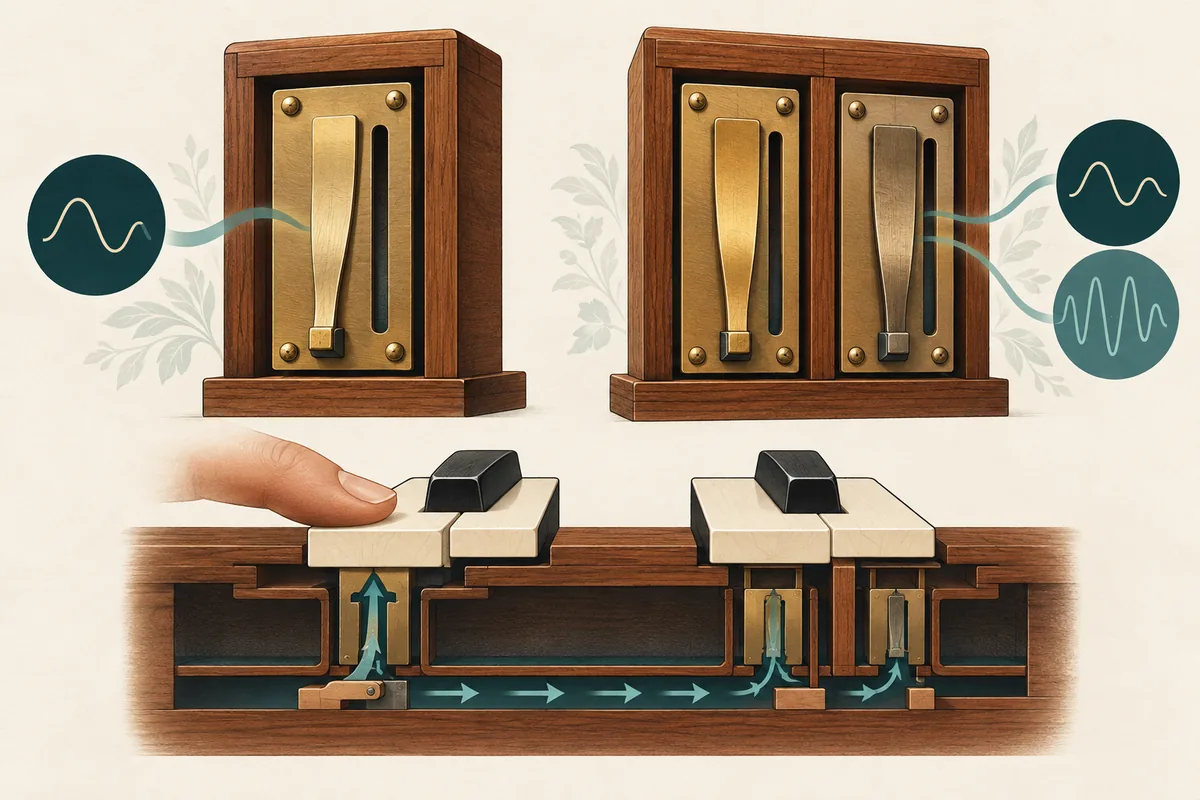
| Setup | Typical impression | Useful check |
|---|---|---|
| One reed bank | Direct, easier to isolate, often economical with air | Use it first when diagnosing one note |
| Two reed banks | Fuller blend and more color | Confirm both banks start together and stay in tune |
| Three reed banks | More range of color or volume on some models | Check air demand, coupler behavior, and balance across registers |
| Coupler engaged | Adds a related octave or paired response | Disengage it before deciding that one reed is unstable |
Why airflow changes harmonium reed response
Players often describe a reed as bright, warm, quick, slow, thin, or buzzy. Those words combine the reed's design with the air system around it.
Listen for attack first. A good note should begin without a long delay when you press the key at a normal practice pressure.
Response is also a musical decision. A very soft single note may be ideal for vocal pitch work, while a blended bank may suit accompaniment.
-
1
Use one familiar note
Choose a middle-register white key that you can find again. Close extra stops and keep the bellows movement gentle.
-
2
Repeat the attack
Press and release the note five times at the same pressure. Notice delay, scratchiness, or a different start each time.
-
3
Hold and listen
Hold the note for several seconds. Listen for a slow pitch drift, flutter, air fade, or a buzz that appears.
-
4
Compare a neighbor
Play the next note with the same setting. A shared change suggests the air path or stop; a single-note change.
A safe ten-minute harmonium reed listening test
You can gather useful evidence without opening the reed board. Work in a quiet room, keep your phone or a notebook nearby, and change one setting at a time.
Start with the instrument level and the bellows relaxed. Confirm that no key, stop, or coupler is partly engaged. Use the same three notes in the low, middle, and high registers.
If the symptom is loud, sudden, or accompanied by a smell of moisture, scorching, or loose material, stop the test. Do not keep pumping to make the noise easier to hear.
-
1
Minutes 0-2: set a baseline
Close extra stops, choose a comfortable volume, and play three repeatable notes once each.
-
2
Minutes 2-4: repeat the suspect note
Press the note five times, then hold it. Write down whether the problem is delay, buzz, weak volume, or pitch.
-
3
Minutes 4-6: change one stop
Add one reed bank or coupler, repeat the same note, and then remove it.
-
4
Minutes 6-8: compare neighbors
Play the note above and below it. Note whether the same sound appears across a small range.
-
5
Minutes 8-10: save evidence
Record the model, stop setting, room conditions, and exact notes.
A browser recording or online harmonium output cannot diagnose a physical reed.
Never insert a pin, wire, brush handle, oil, or compressed air into a reed opening during this test.
Buzzing, weak, late, or uneven harmonium reeds
A buzzing note can come from a reed tongue, a loose plate, dust, a vibrating panel, a valve edge, or a stop combination.
Use isolation before conclusions. Close extra stops, lower the volume, and compare the suspect note with its neighbors.
Pitch is easy to misread when Sa, the coupler, or reed-bank balance changes. Confirm the key and setting before treating a stable reed as faulty.
| What you notice | Low-risk next check | Stop and ask for service when |
|---|---|---|
| One note starts late | Repeat it with one bank and normal pressure | The delay remains or the key feels sticky |
| Metallic buzz | Lower volume and compare the neighboring notes | The buzz persists or grows with ordinary playing |
| Note is weak | Check stops, bellows pressure, and a nearby note | Several banks or valves seem affected |
| Pitch feels unstable | Repeat after the instrument rests and record the setting | The pitch moves while pressure stays steady |
| Many notes fade | Inspect visible bellows folds and close extra stops | Air loss is obvious or the bellows cloth is damaged |
When harmonium reed tuning belongs to a technician
Harmonium reed tuning is delicate because a reed is a spring-like vibrating tongue with very little material to spare.
A technician should handle persistent buzzing, damaged or loose reeds, insects or mould inside the reed board, and any work inside the air chamber.
Bring useful context: the instrument model, age if known, climate, storage conditions, the exact note, the active stops, and whether the change appeared after moving or cleaning the instrument.
- Encyclopaedia Britannica: harmonium - Background on the harmonium as a keyboard free-reed instrument.
- Encyclopaedia Britannica: free-reed instrument - Context for how airflow and a vibrating reed create sound.
Use reed information when you practice or buy
Reed knowledge is most useful when it changes a decision. During practice, choose one bank for a clean pitch reference, then add a second bank only when you need more body.
If you are comparing instruments, ask the seller which reed banks are included, whether a coupler is active, how the instrument was stored, and whether the exact unit has been tuned recently.
For daily music work, keep a small baseline routine. Choose Sa, play a short Sa Re Ga Ma phrase, repeat one note with one bank, then repeat it with your usual accompaniment.
| Goal | Reed setting to start with | What to listen for |
|---|---|---|
| Pitch practice | One clear bank, modest air | Fast attack and stable sustain |
| Sargam drills | One bank or a balanced pair | Even volume from Sa to upper Sa |
| Bhajan accompaniment | Add a second bank only as needed | Fullness without covering the voice |
| Instrument comparison | Test every bank separately | No sudden buzz, delay, or pitch jump |
| Before service | Use the setting that reveals the symptom | A repeatable note and stop combination |
Harmonium reeds FAQ
What is a harmonium reed?
A harmonium reed is a thin metal tongue fixed over a slot.
Are more harmonium reeds always better?
No. Extra reed banks can create a fuller tone, but they also use more air and can make faults harder to isolate.
Why is one harmonium note buzzing?
Dust, a loose plate, a valve edge, a reed alignment issue, a vibrating panel, or a stop combination can all cause a buzz.
Can I tune harmonium reeds at home?
Precise reed tuning is best left to a trained technician. Filing or bending a reed changes pitch and response together and can damage the tongue.
How do I test harmonium reeds before buying?
Play low, middle, and high notes with one bank, repeat the same notes with each additional bank, and listen for clean attacks, even volume.
Can an online harmonium diagnose a reed problem?
No. An online harmonium can confirm note names and practice patterns, but it cannot reproduce physical bellows pressure, reed balance, valve seating, or key feel.
Check the note, then return to the music
Use the online harmonium to confirm Sa, note direction, or a short sargam phrase while you describe the physical reed symptom accurately for yourself or a technician.
Open the online harmonium