
Quick answer: what are harmonium alankar exercises?
Harmonium alankar exercises are short Sargam patterns built from Sa, Re, Ga, Ma, Pa, Dha, and Ni. Instead of only playing the scale straight up and down, you repeat notes in pairs, groups, skips, turns, and rhythmic shapes.
For a beginner, the purpose is not speed. A good alankar makes every note equally clear, keeps the chosen Sa stable, coordinates the fingers, and teaches the ear to recognize a pattern in both directions.
This guide assumes you already know the basic note order. If the keyboard map is still unfamiliar, begin with the harmonium notes for beginners chart and the Sargam notes practice guide. Those pages explain C-as-Sa and movable Sa; this page focuses on repeated exercise patterns.
You can practice every pattern on the online harmonium. Use C as Sa for the first session if you want a simple white-key map, but remember that Sa can move. The musical pattern stays the same when the root changes.
What is Alankar in music?
In this practice context, an Alankar is an organized arrangement of notes used to develop control and musical understanding. The word can have other meanings in language, poetry, jewelry, and names, so the useful search boundary here is Alankar in Indian music, especially Sargam pattern practice.
A straight scale is the simplest exercise: Sa Re Ga Ma Pa Dha Ni Sa, then Sa Ni Dha Pa Ma Ga Re Sa. An Alankar changes that route while preserving a rule. For example, Sa Re, Re Ga, Ga Ma repeats adjacent pairs. Sa Ga, Re Ma, Ga Pa trains skips. Sa Re Ga, Re Ga Ma builds overlapping groups of three.
The rule matters more than the number of notes. You should be able to explain the pattern before playing it, hear when it breaks, and reverse it cleanly. That makes Alankar different from randomly pressing notes or memorizing a long string without understanding its shape.
Practice advice: sing or speak the Sargam syllables while playing. If the voice and hand disagree, slow down immediately.
Beginner boundary: use shuddha notes first. Add komal or tivra notes only when the basic pattern and chosen scale are clear.
Set Sa, posture, fingering, and tempo before you begin
Choose one comfortable Sa and keep it unchanged for the whole practice block. C-as-Sa is visually easy, but D or another key may suit your voice better. Play Sa several times, hum it, and confirm that it feels like home before starting the first pattern.
Keep the wrist level and the fingers curved without stiffness. On a physical harmonium, use the other hand for calm, even bellows movement. On Web Harmonium, concentrate on note length and finger release because the browser removes the bellows task.
Set a slow pulse around 50 to 60 beats per minute. One note per beat is enough. Do not increase speed until you can play the pattern upward and downward three times without a wrong note, an uneven gap, or a tense hand.
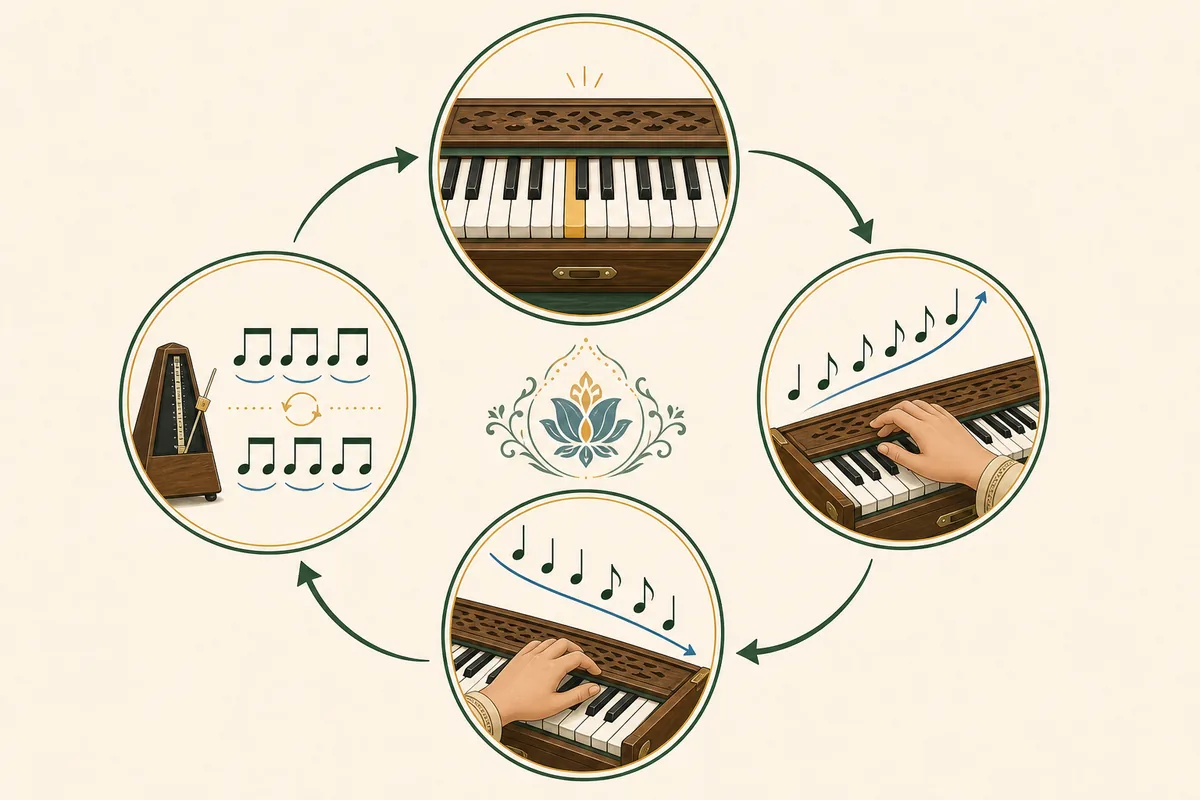
-
1
Choose and hear Sa
Play the root, sing it, and keep that root for the entire drill.
-
2
Say the pattern
Speak the first two groups before your fingers move so the rule is clear.
-
3
Play one note per beat
Use a steady pulse and equal note lengths instead of chasing speed.
-
4
Reverse the pattern
Descending control proves that you understand the shape rather than one memorized route.
10 harmonium Alankar patterns from easy to challenging
The examples use S for Sa, R for Re, G for Ga, M for Ma, P for Pa, D for Dha, and N for Ni. An apostrophe marks the upper Sa. Read each row as a rule, not merely a line to copy. Continue the same rule through the octave, then create the descending mirror.
Practice only two or three patterns in one session. Quality falls quickly when a beginner tries to finish all ten every day. The first four build even movement; the middle patterns train direction changes and skips; the last patterns add rhythm and transposition.
| Exercise | Ascending example | Main skill | Beginner target |
|---|---|---|---|
| 1. Straight scale | S R G M P D N S' | Even notes and a stable root | 3 clean ascents and descents at 50 BPM |
| 2. Adjacent pairs | S R | R G | G M | M P... | Smooth hand movement between neighboring notes | No gap between each two-note group |
| 3. Groups of three | S R G | R G M | G M P... | Overlapping memory and finger preparation | Keep all three notes equal |
| 4. Groups of four | S R G M | R G M P... | Longer pattern control | Finish each group without an accent on the last note |
| 5. Skip one note | S G | R M | G P | M D... | Accurate small jumps | Land without looking away from the active key area |
| 6. Return to the first note | S R S | S G S | S M S... | Root awareness and controlled returns | Make every return to Sa equally calm |
| 7. Up three, back one | S R G R | R G M G | G M P M... | Direction changes | No pause when the pattern turns |
| 8. Four-note wave | S R G R | G M P M | P D N D... | Phrase-like contour | Hear each group as one musical gesture |
| 9. Rhythm change | Play one scale in quarter notes, then eighth notes | Timing without changing fingering | Double the notes only when the pulse stays steady |
| 10. Transposed pattern | Repeat any clean pattern with D or another key as Sa | Movable Sa and interval understanding | Transpose one pattern, not all ten |
The exact fingering may change with the chosen Sa, keyboard range, and teacher's method. Keep the musical rule stable even when a finger substitution is needed.
Stop if the wrist tightens. A short reset protects accuracy better than repeating a tense mistake.
How to finger Alankar exercises without building tension
A beginner often tries to assign one finger permanently to one note. That works for a small area but fails when the pattern crosses the hand position. Instead, plan a quiet thumb pass or finger replacement before you reach the edge of the hand.
For a straight C-as-Sa white-key route, many learners use a piano-like thumb-under movement, but harmonium teachers may choose different fingerings depending on melody style and accompaniment. Follow one consistent method long enough to judge it rather than changing every repetition.
Watch for three warning signs: a lifted shoulder, a wrist that bends sharply, and fingers that strike from high above the keys. Reduce the tempo, keep unused fingers close to the keyboard, and let the smallest necessary movement produce the note.

A seven-day Alankar practice plan for beginners
Use a focused 15-minute session rather than a long, tired session. Begin with two minutes of Sa and the straight scale. Spend eight minutes on the day's patterns, three minutes on the descending versions, and two minutes reviewing the cleanest pattern without looking at the table.
The cycle image shows the whole habit: set the root, climb, return, then repeat a short rhythmic phrase. Do not skip the return. Descending practice exposes weak finger changes that an upward scale can hide.
Record only simple evidence: chosen Sa, patterns practiced, clean tempo, and one mistake to fix. This small log prevents vague practice and makes it easy to resume the next day.
| Day | Main work | Finish when |
|---|---|---|
| 1 | Straight scale and adjacent pairs | Both directions are even at 50 BPM |
| 2 | Groups of three | You can say and play each group together |
| 3 | Groups of four and skip-one pattern | Jumps land cleanly without hand tension |
| 4 | Return-to-Sa and up-three-back-one | Direction changes have no pause |
| 5 | Four-note wave | Each group sounds like one phrase |
| 6 | Rhythm change on two familiar patterns | Faster notes stay aligned with the pulse |
| 7 | Transpose one favorite pattern | The rule survives when Sa moves |
Common mistakes that make Alankar practice less useful
The most common mistake is increasing speed after one correct repetition. A pattern should feel repeatable, not lucky. Require three clean upward and downward cycles before adding even five beats per minute.
Another mistake is allowing rhythm to hide wrong notes. If a note is unclear, remove the metronome, play the group slowly, name every note, and rebuild the pulse afterward. Timing practice cannot repair an uncertain pattern rule.
Do not practice only the easy hand position. Start some sessions in the middle octave, move Sa, or begin with the descending shape. Small controlled variations prove that you understand the interval pattern instead of one visual route.
Finally, do not turn Alankar into a substitute for music. After the drill is clean, use a two- or three-note fragment inside a bhajan, raga lesson, or simple melody. The exercise builds control; the musical phrase teaches expression.
How to use Web Harmonium for Alankar practice
Open Web Harmonium and choose a register that keeps the full pattern inside a comfortable visible range. Play the root first, then test only the first group. If the pattern begins S R G, do not continue until those three notes are clear and evenly spaced.
A browser harmonium is especially useful for silent planning, pitch checks, computer-keyboard repetition, and quick transposition. It cannot teach bellows pressure or judge tone quality, so transfer the same pattern to a physical harmonium when those skills matter.
If you need a broader first-session sequence, use the how to play harmonium guide. It covers posture and basic hand roles; this Alankar page can then become the repeatable technical part of that routine.
When should you move to faster or more advanced Alankars?
Move forward when you can play a pattern in both directions, name the notes while playing, keep a steady pulse, and restart from the middle after a mistake. Those four checks are more useful than one impressive top speed.
Add komal and tivra notes only with a clear scale or raga context. Add ornamentation only when the plain notes are stable. If a teacher gives a different fingering or pattern order, use the teacher's method consistently and treat this list as a practice framework rather than a fixed syllabus.
The best next step is not always a harder Alankar. Sometimes it is applying an easy pattern with better tone, another Sa, a new rhythm, or a short musical phrase. Progress means more control and understanding, not simply more notes.
Harmonium Alankar exercises FAQ
What is Alankar in music?
An Alankar is an organized note pattern used to train pitch, rhythm, fingering, memory, and control. In beginner harmonium practice, it is usually built from Sargam notes and repeated upward and downward according to one rule.
Which Alankar should a harmonium beginner learn first?
Start with the straight scale, adjacent pairs, and groups of three. These patterns build even movement before skips, turns, rhythm changes, or transposition are added.
How fast should I practice harmonium Alankars?
Begin around 50 to 60 BPM with one note per beat. Increase by about five BPM only after three clean upward and downward repetitions with a relaxed hand.
Should I practice Alankar with both hands?
The right hand normally plays the keys while the left hand controls the bellows on a physical harmonium. First stabilize the note pattern, then coordinate it with smooth bellows movement.
Is Alankar the same as Sargam?
No. Sargam is the note-naming system Sa Re Ga Ma Pa Dha Ni. An Alankar is a patterned arrangement of those notes used as an exercise or musical figure.
Can I practice Alankar on an online harmonium?
Yes. An online harmonium is useful for note order, timing, pattern memory, and transposition. Use a physical instrument or teacher for bellows control, touch, and detailed feedback.
Practice one Alankar on Web Harmonium
Choose Sa, set a slow pulse, and play one pattern upward and downward three clean times before adding speed.
Open Web Harmonium