

Quick answer: how do sargam notes work on harmonium?
Sargam notes for harmonium are Sa, Re, Ga, Ma, Pa, Dha, and Ni. A beginner-friendly first map treats C as Sa, then D as Re, E as Ga, F as Ma, G as Pa, A as Dha, and B as Ni.
That chart is a practice starting point, not a fixed rule. In sargam, Sa can move to match the singer or song. Once Sa moves, the same note names keep their musical roles while the physical keys change.
Sargam notes become useful on harmonium only when you know where Sa is, how the seven note roles move, and how to practice a short phrase without rushing into song notation. This guide turns Sa Re Ga Ma into a practical keyboard map you can test on Web Harmonium.
The page is a supporting practice guide for Web Harmonium users. It does not replace the main online instrument, the beginner notes chart, or the song-notes workflow; it connects those resources around the specific sargam intent.
What sargam notes mean on a harmonium keyboard
Sargam names describe scale roles. Sa is the home note, Re is the second step, Ga the third, Ma the fourth, Pa the fifth, Dha the sixth, and Ni the seventh. On a keyboard those roles must be attached to real keys before your hand can practice them.
For a first session, use the harmonium notes for beginners map: C as Sa and the white keys as the clean shuddha route. This makes the pattern visible and lets you hear the distance between notes before you worry about other roots.
The important habit is to say the note name while pressing the key. If your mouth says Sa but your finger lands on Re, the mistake is easy to catch. If you only stare at written letters, you may memorize a finger route without hearing the sargam relationship.
| Sargam note | Starter key when C is Sa | What to listen for | Practice cue |
|---|---|---|---|
| Sa | C | Home and resting point | Begin and end each drill here. |
| Re | D | First step away from home | Move from Sa to Re without sliding. |
| Ga | E | Stable third step | Check that Sa Re Ga sounds even. |
| Ma | F | Middle turning point | Pause here before going to Pa. |
| Pa | G | Strong fifth reference | Use it as a second anchor after Sa. |
| Dha | A | Upper movement | Keep the same tempo as the lower notes. |
| Ni | B | Lead back to upper Sa | Do not rush the return to Sa. |
Choose Sa before reading any sargam line
Most beginner confusion comes from treating Sa like the letter C forever. C-as-Sa is useful because it is simple, but a singer may need D, E, F, or another key as Sa. A bhajan, raga exercise, or classroom notation page may also assume a different root without saying it clearly.
Before you copy a phrase, open the online harmonium, set a comfortable pitch, and sing or hum the first line. If the phrase feels too high or too low, move Sa and keep the same sargam shape. This is the difference between learning the relationship and memorizing one physical keyboard location.
If a page uses western letters, compare it with the harmonium with English keys guide. Letters name fixed keys; sargam names describe roles around Sa. You can connect the two systems, but only after the root is clear.
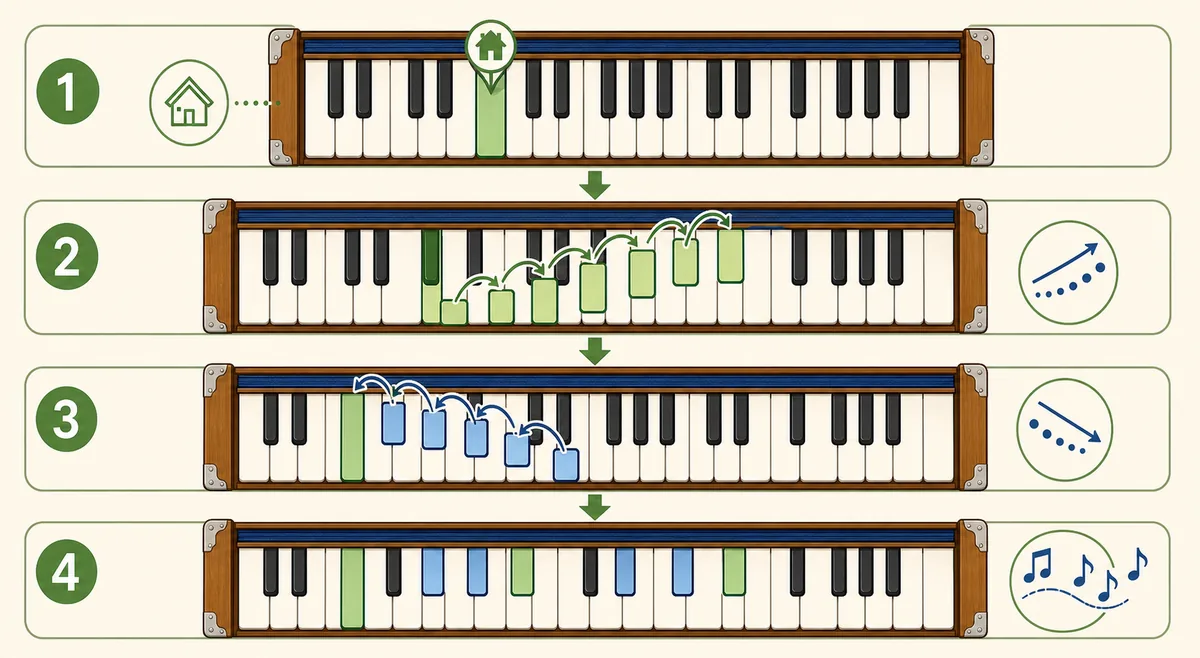
A simple Sa Re Ga Ma practice loop
Do not start with long song notes. Start with one small loop: Sa Re Ga Ma, Ma Ga Re Sa, Sa Re Ga Ma Pa, and Pa Ma Ga Re Sa. Play each note for the same length and leave a tiny silence between repetitions so your ear can judge the shape.
After the lower half feels steady, continue to Pa Dha Ni Sa and return Sa Ni Dha Pa. The return is as important as the climb because many song phrases descend. If the descending notes blur together, slow down and speak the names again.
Use the flow image here as a practice checklist. It is intentionally plain: choose a home key, climb, return, then test a short phrase. That loop is more reliable than jumping between unrelated song snippets.
-
1
Set Sa
Pick one root and keep it for the whole drill.
-
2
Climb slowly
Play Sa Re Ga Ma Pa Dha Ni Sa with even timing.
-
3
Return clearly
Play Sa Ni Dha Pa Ma Ga Re Sa without rushing.
-
4
Test a phrase
Try one two-bar melody only after the scale is stable.
How sargam practice supports Hindi song notes
Searchers often want Hindi sargam notes because they are trying to play a familiar melody. The safer order is scale first, phrase second, full song third. If the scale is not stable, a song-note page can look correct while sounding wrong.
When you move to songs, use the Web Harmonium notes for songs workflow. Break a line into short phrases, check whether it starts on Sa, Pa, or another anchor, and mark any komal or tivra notes before repeating it.
A good rule is to practice only one phrase until you can sing it, say the note names, and play it at the same tempo. If one of those three fails, the phrase is not ready for speed.
Avoid copying long strings of notes from a video description without checking the chosen Sa.
Treat very decorative film melodies as simplified practice material unless the source explains the exact scale and altered notes.
Sa Re Ga Ma Pa Dha Ni Sa notes: a full harmonium example
For a clear beginner reference, read the full line as Sa Re Ga Ma Pa Dha Ni Sa, then return as Sa Ni Dha Pa Ma Ga Re Sa. If C is Sa, the starter western-key map is C D E F G A B C. This is an example for hearing the order, not a rule that fixes Sa to C.
Say each sargam name while pressing the key, then compare the same pattern with the harmonium notes chart and test it on the online harmonium keyboard. When the scale is stable, move to one short song phrase instead of adding more notes at random.
Common beginner mistakes with sargam notes
The first mistake is playing every note with equal musical weight. Sa and Pa usually feel more stable than Re or Dha. When you listen for those anchors, the scale stops sounding like a random row of keys.
The second mistake is ignoring black keys. A plain beginner drill may use only shuddha notes, but real songs and ragas often need komal or tivra notes. Add them only after the basic route is steady, and write a small reminder near the phrase instead of guessing while playing.
The third mistake is practicing only upward. Many melodies move down, repeat a note, or jump from Pa back to Re. Include descending and mixed patterns from the beginning so your fingers do not freeze when a song turns around.
A 15-minute sargam routine for Web Harmonium
Use the first three minutes to choose Sa and play the full scale slowly. Spend the next five minutes on ascending and descending loops. Use another four minutes on one short phrase from a bhajan, bandish, or melody you already know.
Save the last three minutes for correction. Ask what went wrong: wrong Sa, uneven tempo, skipped altered note, or a phrase that is too long. This reflection matters because online practice is fast and convenient, but it cannot listen like a teacher.
If you are completely new, read how to play harmonium after this guide. That page covers posture, hand use, and first-session habits, while this page focuses specifically on sargam-to-keyboard practice. When the straight scale feels secure, continue with the harmonium Alankar exercises guide to practice pairs, grouped notes, skips, direction changes, and a seven-day routine.
Sargam notes for harmonium FAQ
What are the basic sargam notes for harmonium?
The basic notes are Sa, Re, Ga, Ma, Pa, Dha, and Ni. Beginners can first map them to C, D, E, F, G, A, and B, then move Sa when a singer or song needs another pitch.
Is Sa always C on harmonium?
No. C as Sa is a teaching shortcut. In real practice Sa is movable, so the same sargam pattern can begin from another key.
Can I practice sargam notes online?
Yes. Web Harmonium is useful for checking note order, hearing pitch steps, and repeating short phrases. Use a physical harmonium or teacher when you need bellows control and detailed correction.
Are sargam notes and Hindi song notes the same thing?
They overlap, but they are not identical. Sargam is the note naming system; Hindi song notes are a practical melody transcription that may simplify rhythm, ornamentation, or altered notes.
Should I learn chords before sargam?
For harmonium melody and singing support, learn sargam first. Chords can help some accompaniment styles later, but they do not replace clean Sa Re Ga Ma practice.
How do I practice Sa Re Ga Ma Pa Dha Ni Sa notes on harmonium?
Start with C as Sa for a simple visual map, play Sa Re Ga Ma Pa Dha Ni Sa slowly, return to Sa, and repeat the descent. After the order is reliable, move Sa to a comfortable pitch and keep the same note relationships.
Practice sargam on the online harmonium
Open Web Harmonium, set a comfortable Sa, and play one slow Sa Re Ga Ma Pa Dha Ni Sa loop before you move to a full song.
Open Web Harmonium