
Quick answer: how do you use Web Harmonium notes for songs?
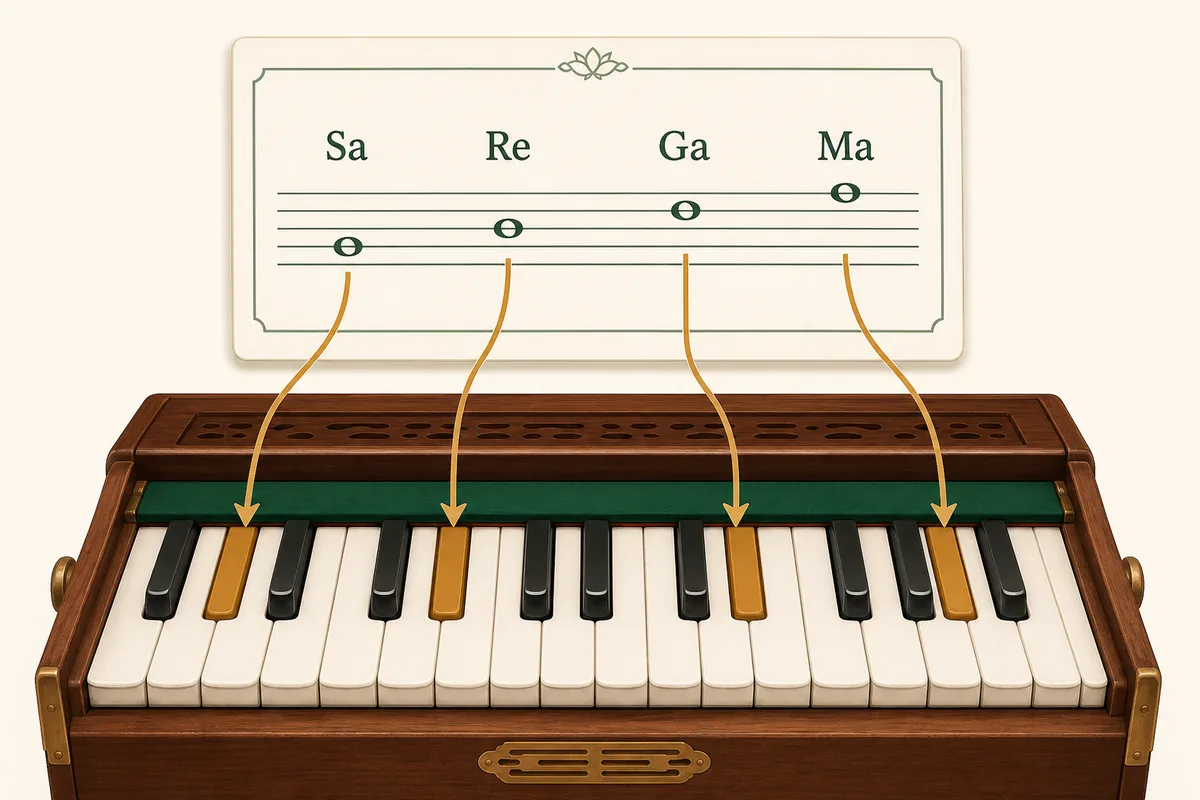
Choose the song's Sa first, then read the notes as short phrases instead of one long line. Map Sa Re Ga Ma or C D E F to the visible harmonium keys, play slowly, and only add rhythm after the pitch order is stable.
If a notes page does not tell you the root, octave marks, or altered notes, treat it as a clue. Check the first phrase on the online harmonium before you memorize the whole song.
The common mistake is opening a song-notes page and pressing letters immediately. That often sounds wrong because one source may use C as Sa, another may write movable sargam, and another may simplify the melody for piano, flute, or a mobile app.
A safer process is to turn the song into small practice decisions: what is Sa, what notation system is being used, where are komal or tivra notes marked, and which two or three notes form the first phrase. Web Harmonium works well for this because you can hear the phrase in the browser before moving to a full physical instrument. For a concrete first song, continue with the Happy Birthday harmonium notes guide, which turns this general method into a four-phrase keyboard map.
Know which type of song notes you are reading
Most song-note pages use one of three formats. Sargam writes Sa, Re, Ga, Ma, Pa, Dha, and Ni. Western letter notes write C, D, E, F, G, A, and B. Mixed pages may put lyrics beside sargam syllables, numbers, octave dots, or keyboard letters.
Before playing, identify the format. If the page says Sa = C, you can use the beginner C-as-Sa layout. If it only lists Sa Re Ga Ma, you still need to choose a root. If it uses C D E letters, check whether the letters are fixed pitches or a simplified keyboard map.
| Format | What it means | How to use it on Web Harmonium | Main risk |
|---|---|---|---|
| Sargam | Relative note roles such as Sa Re Ga Ma | Choose Sa, then map every role from that root | Assuming Sa is always C |
| Western letters | Fixed labels such as C D E F | Match the visible key labels and test the octave | Ignoring the singer's comfortable pitch |
| Mixed lyrics and notes | Lyrics with note syllables above or below words | Practice one lyric phrase at a time | Playing the whole line before checking the root |
| Number or app notation | A simplified system from one teacher, app, or PDF | Read the source instructions first | Using the numbers outside their intended system |
Choose Sa before you map any song phrase
Sa is the home note. For chart practice, many beginners set C as Sa because the white keys are easy to see. For song practice, the useful Sa is the one that fits the singer or the recording. These two goals can be different.
Write the chosen Sa beside the song title. If you are using the online harmonium only to learn the shape, C as Sa is fine. If you are singing, hum the opening line first and move the root until the voice feels relaxed.
Practice rule: never mix two roots inside the same practice session unless you deliberately transpose the whole phrase.
Copyright note: use short original drills for technique, and use legitimate song-note sources or a teacher when you study copyrighted songs.
Map one phrase instead of a full song page
A song page may contain many lines, but your first job is one phrase. Copy only the first four to eight notes, identify the root, and play that phrase at a slow tempo. If the phrase returns to Sa, hold Sa long enough to hear the landing.
Use this original practice phrase to learn the method: Sa Re Ga, Ga Re Sa, Sa Ga Ma Pa. If C is Sa, that becomes C D E, E D C, C E F G. Once this mapping feels stable, repeat the same process on a real song line.
| Phrase piece | Sargam | If C is Sa | What to listen for |
|---|---|---|---|
| Opening | Sa Re Ga | C D E | An even upward step |
| Return | Ga Re Sa | E D C | A clear landing on Sa |
| Small jump | Sa Ga | C E | The skip should not feel random |
| Stable point | Ma Pa | F G | Pa should sound like a strong checkpoint |
A 12-minute online routine for song notes
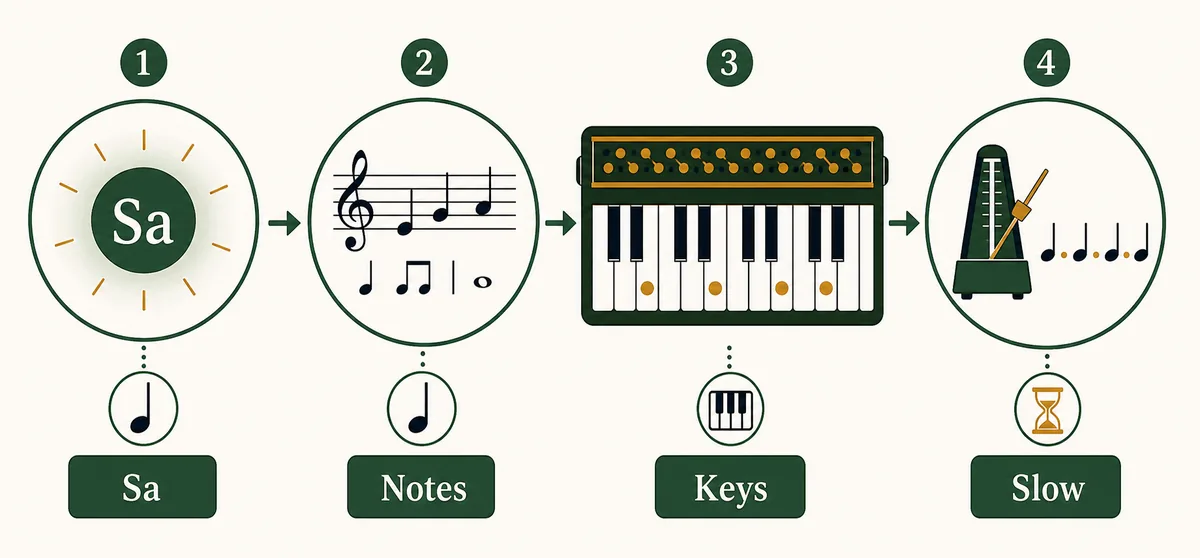
Keep the first session simple. The goal is not to finish the whole song. The goal is to make the first phrase reliable enough that your ear, hand, and notation agree.
Use a clean tone on Web Harmonium while learning. Heavy reverb or extra reeds can make mistakes harder to hear. Add richer tone only after the notes are correct.
-
1
Minutes 0-2: choose Sa
Set C as Sa for chart practice, or choose a comfortable root for singing.
-
2
Minutes 2-4: read the notation
Mark whether the source uses sargam, western letters, mixed lyrics, or another system.
-
3
Minutes 4-7: map one phrase
Write the matching key labels under the first short phrase and play it slowly.
-
4
Minutes 7-10: repeat without looking
Look away for a few attempts, then return to the notes if one pitch feels uncertain.
-
5
Minutes 10-12: add rhythm
Keep the same notes and move slightly closer to the song's rhythm without speeding up.
Common mistakes when using harmonium song notes online
Do not assume every song-notes source uses the same Sa. Do not treat computer keyboard letters as music notation. Do not skip octave marks, komal notes, or tivra Ma if the source marks them.
Another common mistake is practicing from a source that never explains its system. If the first line sounds wrong, do not force it. Compare the root, altered notes, and octave before blaming your hand position.
When to use the Hindi song notes guide instead
If your target is specifically Hindi film songs or bhajans, use the Hindi song harmonium notes guide after this page. It goes deeper into lyric lines, sargam assumptions, and altered-note checks for that style.
For the basic note chart, start with harmonium notes for beginners. For fixed C D E labels, review harmonium with English keys before reading song pages.
Web Harmonium song notes FAQ
Can I play song notes directly on Web Harmonium?
Yes, but first check the notation system and the chosen Sa. Playing letters immediately can sound wrong if the source assumes a different root.
Is C always Sa for harmonium song notes?
No. C as Sa is a beginner-friendly map. For singing or matching a recording, Sa should move to the comfortable pitch.
What if a song page only gives Sa Re Ga Ma notes?
Choose a root, map the phrase from that root, and test the first line slowly. If the source does not name the root, treat it as incomplete.
Can I use western letters instead of sargam?
Yes, if the source clearly uses fixed letters such as C D E. If the letters are only a shortcut for an app or keyboard, read that source's instructions first.
Should I memorize the full song at once?
No. Map one short phrase, repeat it slowly, then connect phrases after the pitch order is stable.
Try one song phrase on the online harmonium
Open Web Harmonium, choose Sa, and test the first four to eight notes before practicing a full song.
Open the online harmonium