
Quick answer: what does a lehra do?
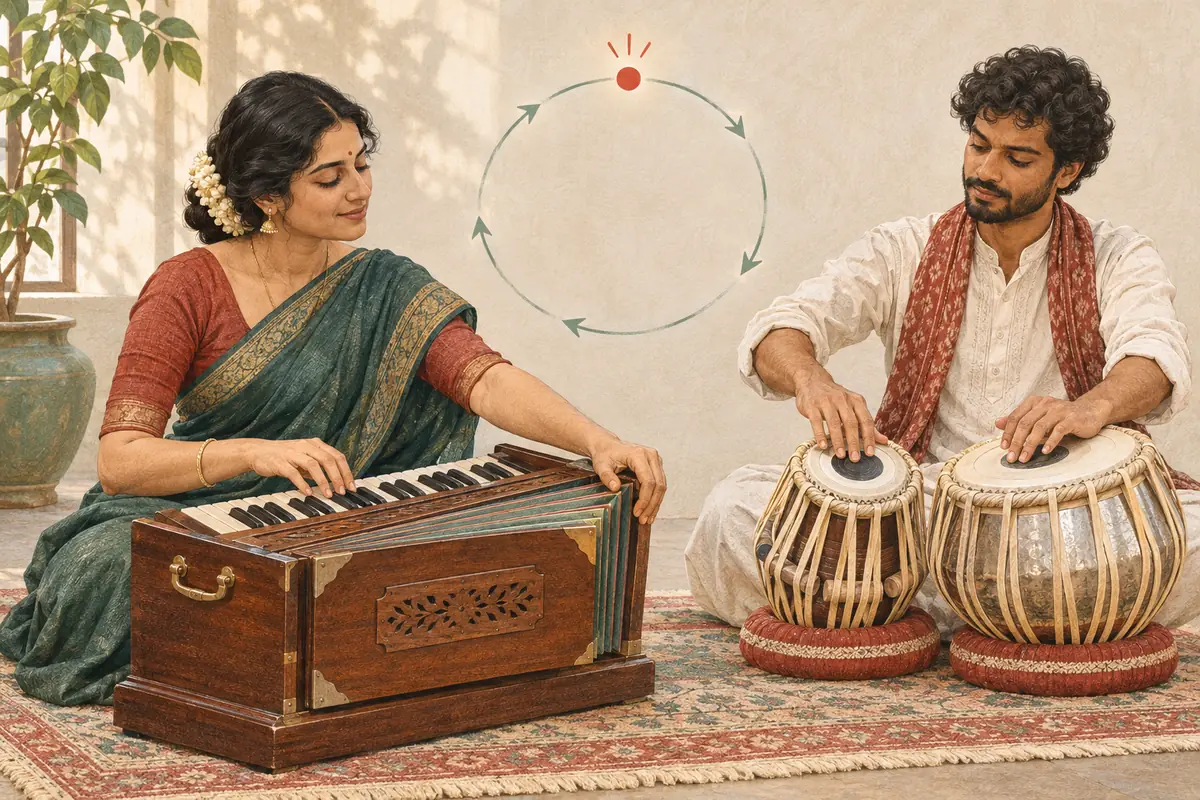
A lehra is a repeating melodic phrase aligned to a chosen taal. When a tabla player performs a solo, the melody marks the cycle and gives both musicians a shared point of return: sam.
To play one on harmonium, choose the cycle and a comfortable pitch, make one clear phrase that fits the cycle, then repeat it evenly while listening to the tabla.
The job is support, not display. A good practice lehra stays recognizable, leaves room for the tabla, and makes the cycle easy to follow. Start with a phrase you can play accurately at a slow tempo; speed and ornament can come later.
For general setup, see the beginner harmonium steps.
Lehra, taal, avartan, and sam in plain language
Lehra is also called nagma or lahara in some contexts. It is a melodic accompaniment, commonly played on harmonium or sarangi, that repeats with a rhythmic cycle. It does not replace the tabla: the tabla player supplies the rhythmic improvisation, while the lehra helps keep the cycle audible.
One complete taal pass is an avartan. Vibhag are its sections; sam is the main return point. Conventions vary, so confirm the exact cycle and accents with the tabla player or teacher.
The iLehra description and Riyaz glossary both describe the repeating phrase as a guide through the taal cycle, not a universal tune.
| Term | Practical meaning | What to listen for |
|---|---|---|
| Lehra / nagma | A repeating melodic accompaniment | The phrase returns consistently |
| Taal | The selected rhythmic cycle | The tabla player's agreed pattern |
| Avartan | One complete cycle | The start and end connect |
| Vibhag | A section within a cycle | Accents or claps that distinguish sections |
| Sam | The cycle's main return point | Both players arrive together |
Choose the taal, Sa, raag, and tempo before you play
Agree on the taal first. Ask the tabla player to demonstrate a full cycle, including its accents and sam; beat count alone does not identify the grouping.
Set Sa to a comfortable pitch. If a raag is being used, confirm its notes and phrase shapes. A scale drill helps locate keys but is not automatically suitable for every raag.
Start at a tempo where the cycle stays clear. A metronome can mark pulse, but it cannot explain the taal or replace listening to the tabla.
-
1
Hear the cycle
Ask the tabla player to clap or speak one complete taal, including the return to sam.
-
2
Set Sa
Find a comfortable tonic and keep it stable while you form the phrase.
-
3
Confirm the raag
Check which notes and phrase shapes are appropriate; ask before adding ornament.
-
4
Begin slowly
Use a tempo where each note and each cycle boundary stays clear.
How to Play Lehra on Harmonium: build one complete cycle
Build one complete cycle: give the opening a clear identity, keep the middle easy to repeat, and make the return to sam audible. A simple phrase is easier to keep steady and leaves space for tabla improvisation.
The diagram is conceptual, not a notation chart for a specific taal or raag. The note pattern below is an original coordination drill with four equal positions per group, not a traditional lehra. Change it to fit the raag or teacher's notation.
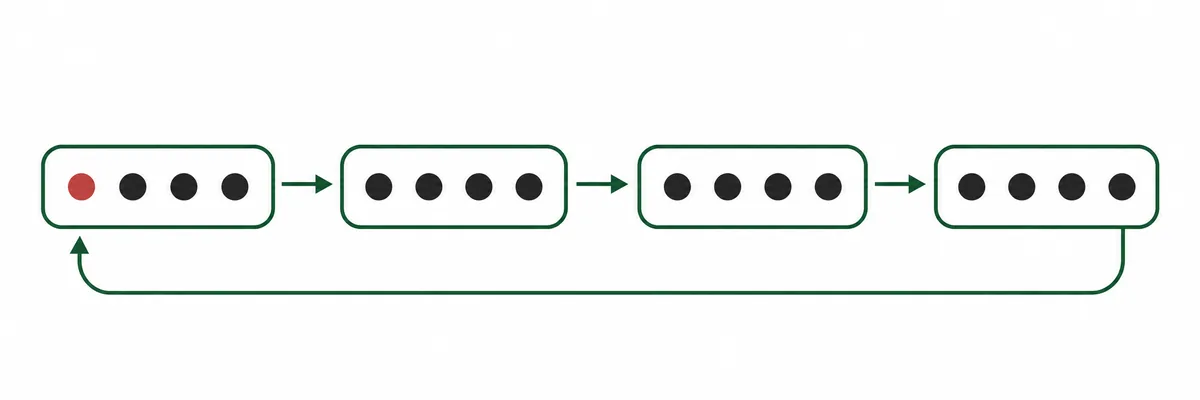
| Practice group | Original exercise notes | Focus |
|---|---|---|
| 1 | Sa - Re - Ga - Re | Start clearly and keep the pulse even |
| 2 | Ga - Ma - Pa - Ma | Keep the phrase light |
| 3 | Ga - Ma - Pa - Ga | Do not rush as the cycle continues |
| 4 | Re - Ga - Re - Sa | Make the final Sa lead naturally back to the first beat |
Keep the lehra steady and make the return to sam clear
Consistency matters more than decorative runs. First play the phrase with plain note lengths and a comfortable bellows movement. Listen for the beginning of every cycle. If the phrase drifts ahead of the tabla, reduce the tempo and count the agreed grouping aloud before adding any embellishment.
Use agreed accents as landmarks rather than stressing every note. Keep the ending connected to the next cycle. A quiet lehra that leaves room for the tabla is more useful than a loud melody.
Practice several cycles, then check whether they return together on sam. A metronome may reveal drift, but listening and counting the taal remain central.
| What you notice | Likely adjustment |
|---|---|
| The phrase rushes near its end | Slow down and count the final section separately |
| The tabla return feels unclear | Simplify the last notes and confirm sam together |
| The harmonium masks the tabla | Reduce volume and leave more space in the melody |
| You lose the cycle after a flourish | Remove the flourish until the plain phrase is stable |
A 15-minute lehra practice routine
-
1
Minutes 0-3: clap and count
Without playing, say or clap one complete cycle with the tabla player or a trusted recording. Mark the return to sam.
-
2
Minutes 3-6: play one plain phrase
Use a very short phrase and repeat it slowly. Stop if the beat count or grouping becomes unclear.
-
3
Minutes 6-10: repeat without stopping
Play several cycles in a row, keeping the volume modest and listening for drift.
-
4
Minutes 10-13: add the tabla
Agree on tempo and volume. Keep the lehra predictable while the tabla player explores.
-
5
Minutes 13-15: review
Name one moment where sam aligned and one place that needs a slower repeat. Change only one thing next time.
Practice with a tabla player, teacher, or recording
Before a shared session, agree on taal, tempo, Sa, raag, and how to stop. Ask whether the tabla player wants a plain lehra. During the solo, keep listening and do not change the cycle or pitch without agreement.
A recording may use a different pitch or interpretation, so treat it as a reference, not a universal rule. For broader context, read about harmonium in Indian classical music. The online harmonium keyboard can help locate notes but cannot replace physical bellows or a tabla player's guidance.
- iLehra: About the Tabla and Lehra Accompaniment - First-party description of lehra's role and common usage controls.
- Riyaz: Lehra meaning in Hindustani classical music - Glossary context for the repeating phrase, taal cycle, and sam.
- Shawn Mativetsky: iLehra app and tabla practice - Tabla performer notes on selecting pitch, taal, raag, and tempo for practice.
Common lehra mistakes and simple corrections
A melody can be playable yet unhelpful if it hides the tabla or drifts from the agreed cycle. Simplify it before increasing volume or adding notes.
Online notation may assume another Sa, raag, taal, or composition version. Check its source and assumptions. The sargam guide explains movable Sa, not interchangeable phrases.
| Mistake | Why it causes trouble | Try this |
|---|---|---|
| Adding too many ornaments | The cycle becomes difficult to hear | Repeat a plain phrase until it is steady |
| Changing Sa mid-session | The melody and tabla reference no longer match | Confirm pitch before starting |
| Choosing the phrase before the taal | The melody may not fit | Agree on the cycle first |
| Calling an exercise a traditional lehra | It can mislead learners about musical context | Label original drills and verify repertoire with a teacher |
How to Play Lehra on Harmonium: FAQ
What is lehra on harmonium?
It is a repeating melodic accompaniment, often played on harmonium or sarangi, that follows a selected taal during a tabla solo and helps mark the cycle's return to sam.
How do I start playing lehra on harmonium?
Agree on the taal, Sa, raag, and tempo with the tabla player. Hear one complete cycle, choose a simple phrase that fits it, and repeat evenly before adding ornament.
Can I use the same lehra for every taal?
No. The phrase must fit the selected cycle and its accents. Confirm the grouping and sam with the tabla player rather than moving one pattern between taals without checking.
Can I practice lehra without a tabla player?
Yes. You can clap the cycle, count the groupings, or use a reliable recording as a reference. A metronome helps with pulse but cannot explain the full taal structure or replace feedback from a musician.
Can an online harmonium play or check a lehra?
A browser keyboard can help you find notes and try a short phrase. It does not reproduce physical bellows technique, tabla interaction, or the musical judgment needed to choose a suitable lehra.
Check the notes, then practice the cycle
Use the online harmonium keyboard to locate your Sa and test a short phrase. Keep the taal agreement and the tabla player's timing as your main reference.
Open the online harmonium