
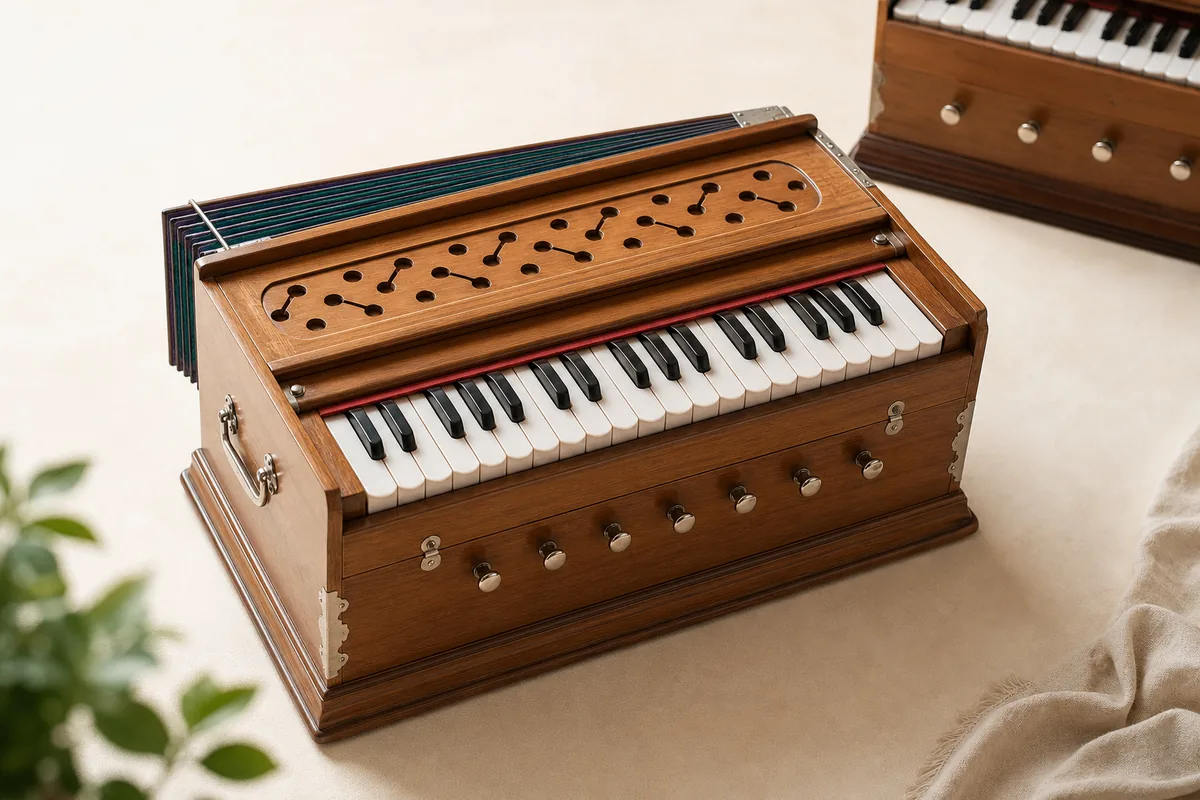
How many keys does a harmonium have? Quick answer
Harmoniums do not share one universal keyboard length. Common product specifications include 32, 37, 39, and 42 playing keys, while some larger or specialist instruments use other layouts.
Treat the number as a starting specification, not a guarantee of range. Before buying, confirm the lowest and highest notes, whether the count includes every visible key, and whether the listing refers to one manual or a special model.
The practical answer to “what is the standard harmonium keyboard number of keys?” is that there is no single standard accepted across every maker and model. A compact harmonium can have fewer keys for portability, while a wider instrument can give a singer or accompanist more room for lower and higher phrases.
Listings may show 32, 37, 39, or 42 keys. Treat those as model examples, not a universal standard: ask for the lowest and highest notes and confirm whether the count includes every playable key.
For a beginner, the best first decision is usually not “buy the most keys.” It is “choose enough range for the music I play, then check bellows, reed response, tuning, stops, case quality, repair support, and weight.”
Common harmonium keyboard key counts
The table below is a decision aid, not a promise that every 32-, 37-, 39-, or 42-key instrument uses the same notes or construction.
A wider keyboard may provide more phrase space, but it can also add size, weight, and cost.
When you compare harmonium models, read the key count together with the stated note range. Two instruments with a similar number of visible keys can still differ in layout, tuning reference, reed configuration, stop arrangement, and the lowest or highest usable note.
Use the following ranges to frame a conversation with a seller. Ask for a specification sheet or a clear keyboard photograph instead of assuming that a number alone tells you the full playing experience.
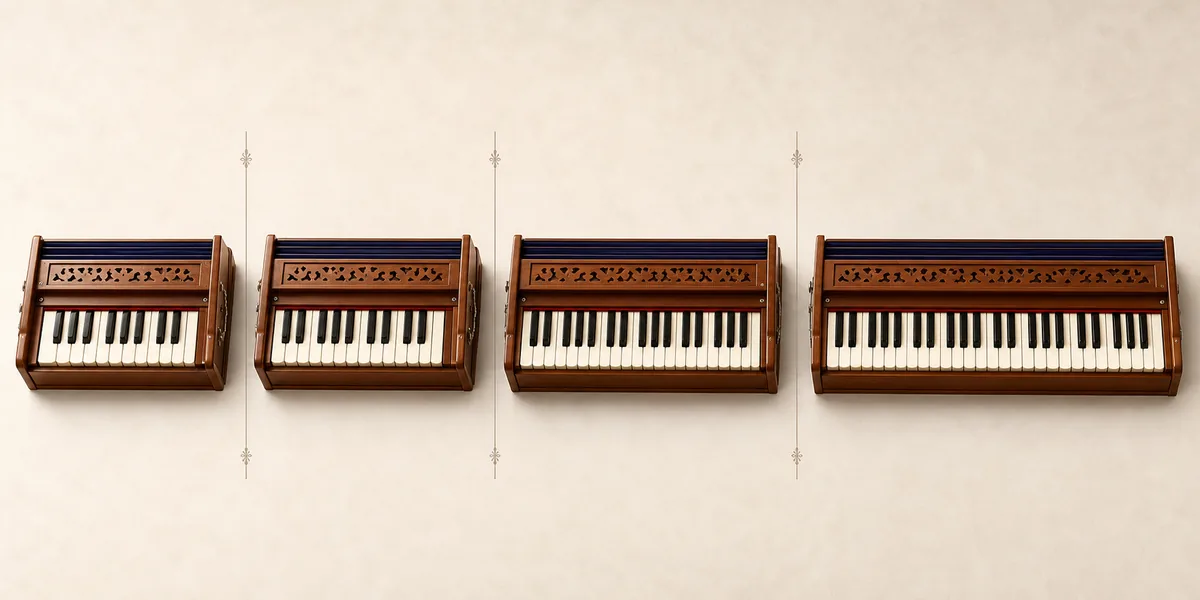
| Listed key count | What it may suit | What to verify before buying | Main trade-off |
|---|---|---|---|
| 32 keys | Compact practice, travel, or a limited repertoire | Lowest/highest note, black-key inclusion, and whether the range covers your songs | Smaller and easier to carry, but less room at the edges |
| 37 keys | A middle option for learners who want more range without a very large case | Actual octave span, key spacing, stops, and case dimensions | Balanced size, but the model may still be heavier than expected |
| 39 keys | Broader melody and accompaniment work when the instrument remains portable enough | Whether the seller counts all playing keys and how the extra range is distributed | More range can mean more size, weight, and price |
| 42 keys | Players who need extra lower or higher notes for accompaniment and varied phrases | Full note map, reed response at the edges, bellows quality, and transport weight | Wider range may be less convenient for small rooms or frequent travel |
What does a harmonium key count include?
The phrase “number of keys” sounds precise, but product pages do not always explain the same counting convention in the same way.
Look for the complete note map rather than treating a marketing number as the whole specification.
First, ask whether the listed number means every playable key on the manual or only a subset described in a short product title. In a chromatic layout, white and black keys are both part of the playing surface, but a seller may describe the instrument with a range, a key count, or both.
Second, separate key count from octave coverage. A model may advertise 37 keys while using a particular low-to-high arrangement; another model with a similar count may distribute the notes differently. The number does not tell you where middle C, Sa, or the instrument's practical pitch center sits.
Third, check whether the photograph and specification refer to the same model. Marketplace listings can reuse photos or shorten descriptions. A reliable listing should let you match the stated count with a visible keyboard, a note-range description, and the exact model name.
Why the word standard can mislead
A beginner may search for a standard number because one answer feels easier to compare. In practice, standard often means common in one catalog, not required for every harmonium.
If a seller cannot provide the lowest note, highest note, total playing keys, and a model-specific photo, that missing information matters more than a larger key-count claim.
How to count the keys on a harmonium
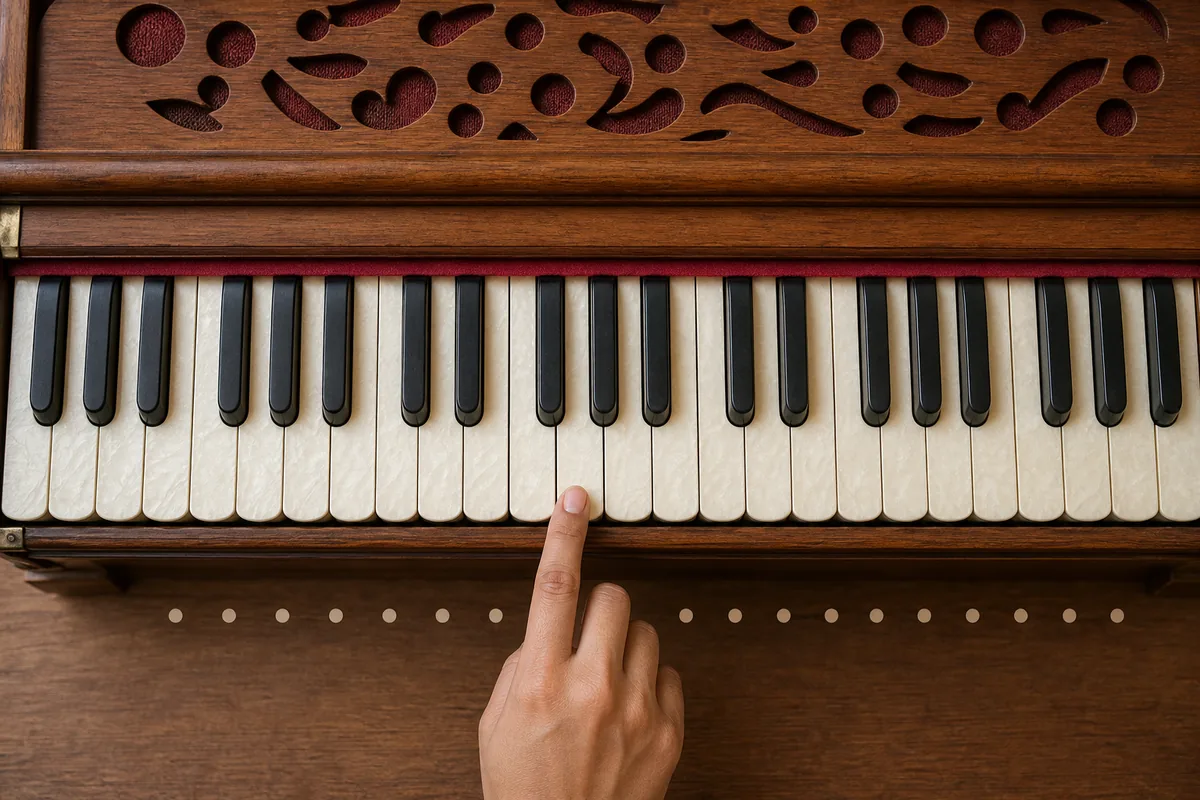
You can verify a physical harmonium in a few minutes if you count the playing keys and record the actual end notes.
Do not count decorative panels, stop knobs, reed covers, or bellows parts as keyboard keys.
If you are inspecting an instrument in person, start at the leftmost key that produces the intended note and move across the manual one key at a time. Count both white and black playing keys when the specification refers to the full keyboard surface.
Then write down the lowest and highest note names if you know them, or ask the seller to provide them. This second step turns a bare number into useful range information for song notes, sargam, accompaniment, and vocal practice.
For an online listing, compare three things: the title, the specification table, and the photograph. If they disagree, pause the purchase and ask for a model-specific answer.
-
1
Find the first playable key
Ignore the wood frame and start with the first key that belongs to the manual and produces a note.
-
2
Count every playing key
Move left to right and include the black keys when you are checking the total visible playing surface.
-
3
Record the end notes
Ask for the lowest and highest notes or test them with a trusted reference; this is more useful than the number alone.
-
4
Match the model to the listing
Compare the physical layout, model name, specification sheet, and photograph before treating the advertised count as verified.
Which harmonium key count is best for a beginner?
Choose the smallest range that comfortably covers your repertoire and singer, not the largest number printed in a listing.
If you mostly practice short melodies, basic sargam, or one vocal range, a compact instrument may be enough. If you accompany different singers or play phrases across a wider register, extra range can be useful.
A 32-key instrument can make sense when portability and a focused practice repertoire matter most. A 37-key or 39-key model may feel like a more flexible middle ground. A 42-key model can be attractive when you regularly need more register space, but only if the extra size and weight fit your room, transport, and budget.
The key count should be checked alongside the instrument's sound and mechanics. A well-built smaller harmonium with responsive reeds, stable tuning, healthy bellows, and comfortable action can be a better beginner choice than a wider instrument with leaks or inconsistent keys.
For a fuller buying checklist, see Best Harmonium for Beginners and the Harmonium Price Guide. For sound and parts, read the Harmonium Instrument guide.
| Your priority | What to favor | What not to assume |
|---|---|---|
| Frequent travel | Compact case, reliable bellows, manageable weight | Fewer keys automatically means better quality |
| Beginner song practice | Enough range for your actual song notes and comfortable Sa | A large key count will fix a mismatched Sa |
| Vocal accompaniment | A range that supports the singers you accompany | Every 42-key model has the same low and high notes |
| Budget buying | Sound test, tuning, repair path, and seller support | The key-count number alone predicts value |
Key count versus the other buying checks
Key count answers only one part of the instrument question. Bellows should hold air without obvious leaks, reeds should respond evenly across the range, stops should work as described, and the keyboard should not have stubborn or noisy keys.
Also check portability. A wider keyboard can be helpful at home but awkward on public transport or in a small teaching room. If you buy used, ask about repairs, tuning history, wood swelling, reed noise, and whether the case protects the keyboard.
Use the beginner notes guide or English-key guide to understand the layout. Web Harmonium helps with note relationships, but its virtual range does not define a physical harmonium's key count.
A simple final buying question
Before you pay, ask one clear question: How many total playing keys are there, what are the lowest and highest notes, and does the photo show the exact model?
Harmonium keyboard number of keys FAQ
How many keys does a harmonium have?
There is no single universal standard. Listings commonly show 32, 37, 39, and 42 playing keys, but the exact note range and counting convention must be checked for each model.
Is a 32-key harmonium enough for a beginner?
It can suit sargam, short melodies, and limited repertoire when the range fits. Check the lowest and highest notes before buying.
What is the difference between 37, 39, and 42 keys?
The difference is keyboard space, but practical range depends on the model. More keys may help broad phrases while increasing size, weight, or price.
Does a key count include black keys?
It depends on the seller's specification convention. Ask whether the number means every playable key on the manual and request the lowest-to-highest note map or a model-specific photograph.
Does a physical harmonium have the same number of keys as the online harmonium?
Not necessarily. The online harmonium is a browser practice tool with its own virtual range and keyboard mapping. Use it to learn note relationships, not to infer the key count of a physical instrument.
Should I buy the harmonium with the most keys?
Not automatically. Match the range to your repertoire and singers, then compare bellows, reeds, tuning, action, portability, service, and total cost.
Practice the keyboard layout before you buy
Use the online harmonium to review note relationships and a comfortable Sa, then confirm the physical instrument's key count and range with the seller.
Open the online harmonium