
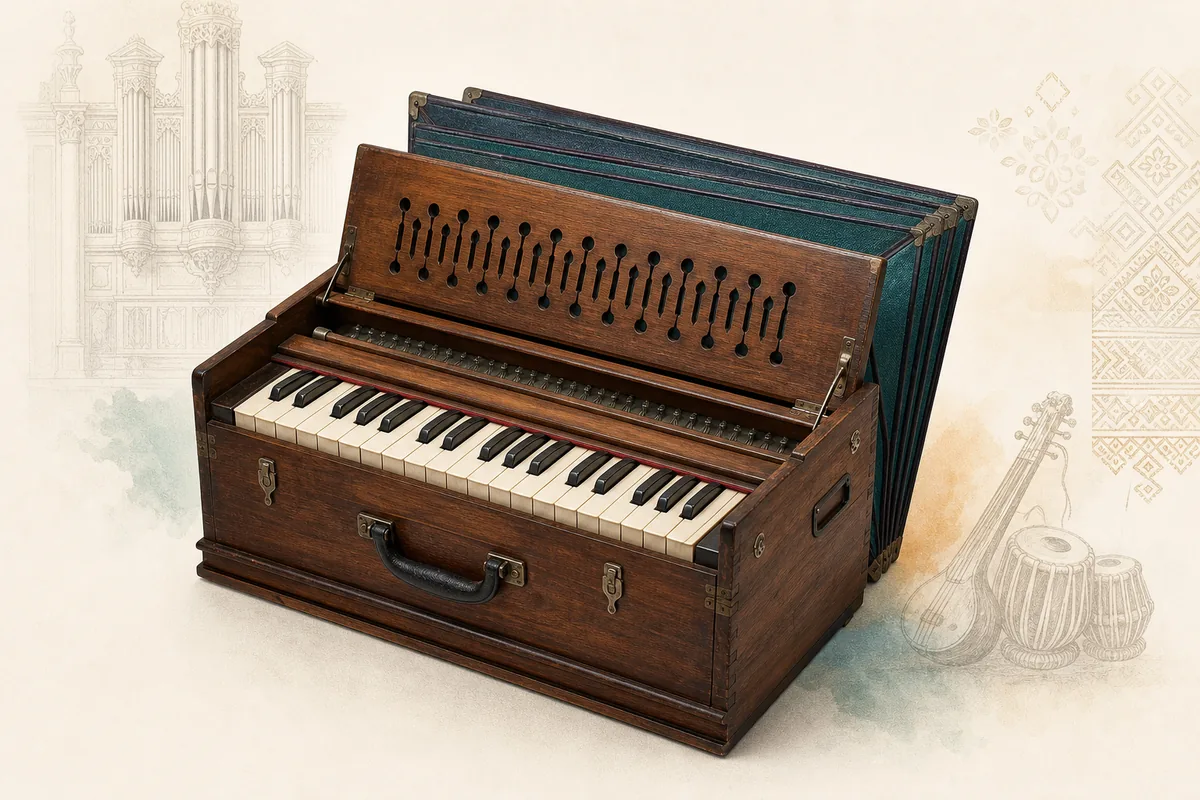
Quick answer: when was the folding harmonium invented?
There is not a single verified invention date for the folding harmonium. The harmonium itself belongs to the nineteenth-century European free-reed instrument family; the compact Indian folding form emerged later as makers and players prioritized transport, floor-level playing, and accompaniment for vocal music.
A commonly repeated secondary account places an important folding-harmonium milestone in 1954 and associates it with Jogesh Chandra Biswas. That date is useful as a reported milestone, but it should not be presented as a universally proven first invention. The historical record is clearer about gradual adaptation than about one isolated workshop moment.
That distinction matters because “harmonium” can describe several related shapes: a tall European cabinet instrument, a smaller portable harmonium, an Indian harmonium with hand bellows, and a folding or suitcase-style design. They share free reeds and a keyboard, but they do not share the same case, bellows arrangement, or cultural history.
If you are learning the instrument rather than researching its history, start with the practical overview in Harmonium Instrument: Parts, Sound, Uses, and Beginner Practice. This page focuses on the narrower history question and explains why a careful answer needs dates, design terms, and source caveats together.
The European harmonium came before the folding Indian form
The harmonium grew out of the nineteenth-century free-reed tradition. Air passes over metal reeds, and the pressure difference makes the reeds vibrate. A keyboard selects pitches while bellows supply the air. That basic sound-making idea links the harmonium to other free-reed instruments, but the harmonium became a distinct keyboard instrument with its own case, stops, and playing technique.
Alexandre Debain is widely credited with patenting the harmonium in Paris in 1842. Some historical accounts give an earlier 1840 date or describe a sequence of prototypes and patents, so the exact “first” date depends on whether a source means the first experiment, the patent, or the commercially recognizable instrument. The stable point is the decade: the European harmonium was established long before the compact folding design became the form most people associate with Indian music.
Early European instruments were often cabinet-like and designed to stay in one room. Their visual language could resemble a small reed organ, with a substantial wooden case, pedals or a different bellows system, and a footprint that was not optimized for carrying between lessons or performances. That is why a history of the folding harmonium cannot simply use the European patent date as the answer.
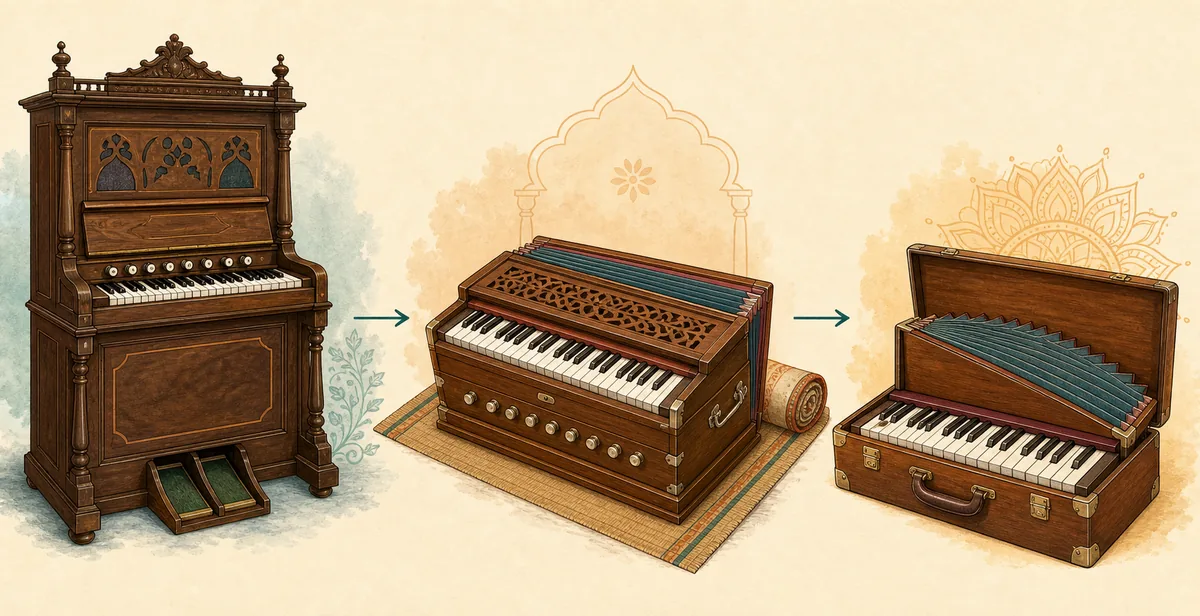
How the harmonium became an Indian practice instrument
The harmonium entered Indian musical life during the nineteenth century and was gradually adapted to local performance and teaching needs. Its sustained tone made it useful for holding Sa, outlining a melody, supporting a singer, and rehearsing devotional or classical material. Its fixed keys also made pitch relationships visible to beginners who were still connecting voice, sargam, and keyboard movement.
The Indian form changed more than its musical reputation. Makers and players favored a lower, portable case that could be used on the floor, carried to a lesson, and opened quickly for accompaniment. Hand-operated bellows became central to the playing routine. The resulting instrument was not merely a European cabinet harmonium made smaller; it was a practical redesign shaped by how Indian musicians sat, sang, travelled, and accompanied.
This is also why “who invented the harmonium?” and “who invented the folding harmonium?” are different questions. The first points toward European invention and patent history. The second asks about later Indian construction and use, where multiple makers, workshops, players, and design changes may matter more than one named inventor. For musical context, compare this history with how harmonium is used in Indian classical music.
Historical boundary: an instrument’s arrival in a region, its adoption by musicians, and its later redesign are separate events. A good timeline should not collapse them into one invention date.
Terminology note: “portable harmonium,” “Indian harmonium,” “folding harmonium,” and “suitcase harmonium” can overlap in casual writing, but they may describe different case and bellows arrangements in a specific catalog.
When did the folding harmonium appear?
The most honest answer is that the folding form appeared through a period of portable design rather than through one universally documented launch. A folding case solves a clear practical problem: it protects the keys and bellows when closed, reduces the carrying profile, and lets a player set up a usable keyboard instrument without transporting a tall cabinet.
A 1954 milestone is often repeated in summaries of the Indian folding harmonium and is commonly connected with Jogesh Chandra Biswas. Treat that statement as a reported attribution, not as a fully settled patent conclusion. The available sources are stronger on the broader development of Indian harmonium construction than on a single, independently verified first folding unit. This distinction is the key information gain for the query: a precise-looking year can hide a complicated design history.
A better way to read the date is: by the middle of the twentieth century, folding and highly portable harmoniums were established enough to be discussed as a recognizable design direction. The design may have had predecessors, parallel workshop versions, or incremental changes that are not captured by the most repeated attribution. If a seller claims a particular model is the first folding harmonium, ask for a catalog, patent, museum record, or maker history rather than relying on the label alone.
| Question | Best-supported answer | Confidence |
|---|---|---|
| When was the harmonium invented? | The European harmonium was established in the 1840s; 1842 is the commonly cited Debain patent year, while some accounts mention 1840 in the development sequence. | High for the decade; medium for the exact first-date wording |
| When was the folding harmonium invented? | The portable folding form developed later in India. A 1954 milestone is often reported, but the first invention claim is not uniformly documented. | Medium for the milestone; low for an absolute first |
| Who invented the folding harmonium? | Jogesh Chandra Biswas is a commonly repeated attribution for the 1954 folding milestone, but later makers and incremental design work should not be erased from the story. | Medium and source-dependent |
What makes a folding harmonium different?
Folding is a construction choice, not a separate sound-producing principle. The reeds, keyboard, stops, and air path still need to work together, but the case is arranged around portability. Hinges, latches, handles, collapsible bellows, and a protected keyboard become part of the instrument’s musical usability.
A folding case can make travel easier, but compactness creates tradeoffs. A smaller body may reduce internal space for resonant chambers, limit the number of keys or stops, and leave less room for repairs. The bellows must still deliver stable air pressure, and the case must close without stressing the reed board or keyboard. These are practical design questions, not proof that one form is historically “better.”
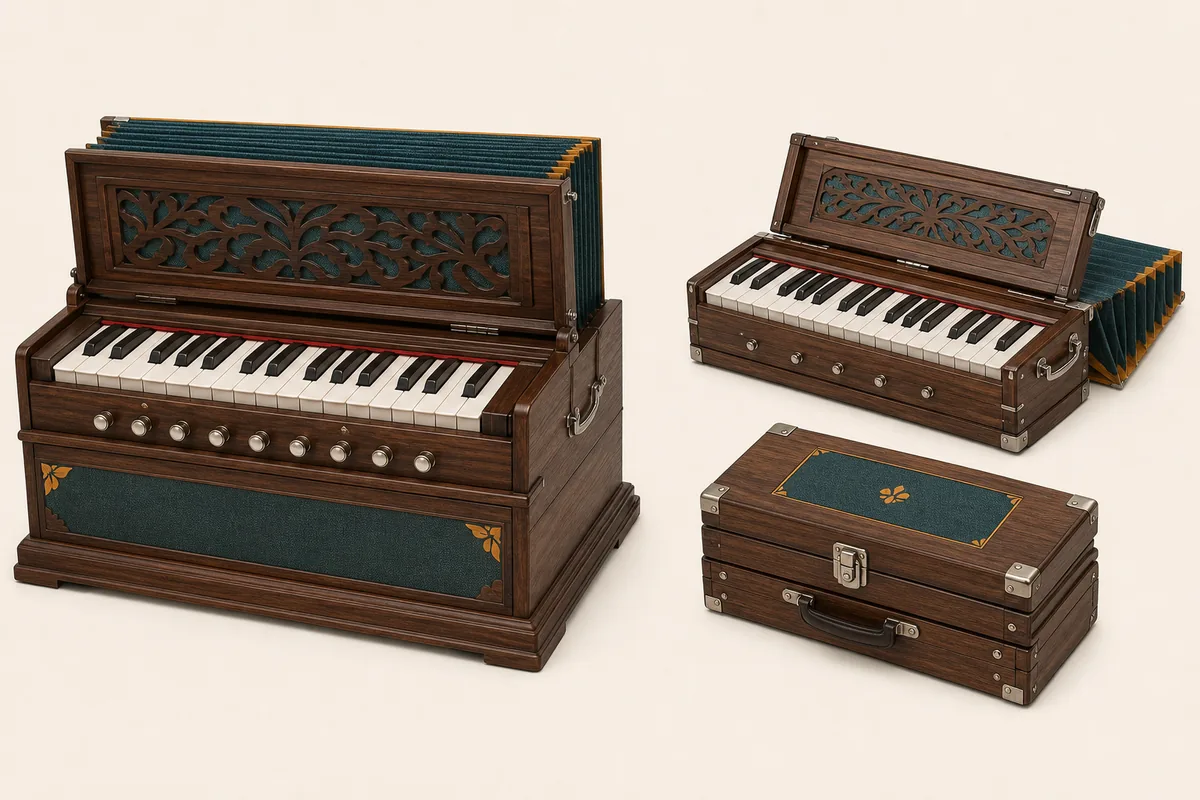
| Feature | Cabinet harmonium | Folding or suitcase-style harmonium |
|---|---|---|
| Main priority | Stable room-based playing and a larger case | Transport, quick setup, and a protected closed form |
| Case | Tall or substantial cabinet construction | Hinged panels, latches, handles, or a case that closes around the keyboard |
| Bellows | May use a larger or different pedal/bellows arrangement depending on the model | Usually designed for hand operation and compact storage |
| Buying question | Does the instrument sound stable and suit the room or accompaniment job? | Does it close safely, travel well, and still provide reliable reeds, keys, and bellows? |
A cautious folding harmonium history timeline
The following timeline separates firm context from lower-confidence attribution. It is designed to answer the search question without turning a convenient summary into a false certainty.
In the 1840s, the European harmonium became a recognizable free-reed keyboard instrument. During the later nineteenth century, the instrument travelled and was adopted in Indian musical settings. Over the twentieth century, Indian makers and musicians refined portable cases, hand bellows, stops, and practical layouts. The often-repeated 1954 date is best treated as one reported folding milestone inside that longer evolution, not as the only moment when portability was invented.
The final stage is the modern learning context. Today, a physical folding harmonium may sit beside electronic keyboards, digital samples, and browser instruments. The historical lineage still helps a beginner understand why the instrument has sustained notes, hand bellows, a compact case, and a close relationship with vocal practice.
| Period | What changed | How certain is the summary? |
|---|---|---|
| 1840s Europe | The harmonium is established through free-reed keyboard development and patent history. | Well supported at the decade level |
| Later 19th century | The instrument spreads beyond Europe and enters Indian musical and educational settings. | Broad history is supported; individual routes vary by source |
| Early to mid-20th century | Portable Indian construction becomes increasingly important for singers, teachers, and performers. | Supported as a development trend |
| 1954 reported milestone | A commonly repeated account connects Jogesh Chandra Biswas with a folding harmonium design. | Use as a qualified attribution, not an absolute first |
| Today | Folding harmoniums remain useful where portability and vocal accompaniment matter, while online tools help with short practice checks. | Practical present-day observation |
What this history changes for a learner or buyer
History should improve your questions, not make you choose an instrument by age or a famous name alone. If you are buying, inspect the exact unit: do the bellows hold air, do the reeds speak evenly, do the keys return cleanly, do the stops work, and does the folding hardware close without rubbing or forcing the case? The practical checks in our harmonium price guide and beginner buying guide are more useful than a vague claim that a model is “traditional.”
If you are learning, the folding form explains why the instrument is so convenient for vocal practice: it can travel, open quickly, hold Sa, and support short phrases. It does not remove the need to listen or sing. Use the browser instrument for a fast pitch check, then connect the pattern to the Sargam notes guide or the beginner playing steps before you try a full song.
The historical lesson is simple: design follows use. The European cabinet, the Indian hand-bellows harmonium, and the folding suitcase form solve related but different problems. Understanding that difference helps you read product descriptions, compare sources, and avoid repeating a neat date when the evidence actually describes a long adaptation.
Buying caution: a folding case is not automatically a sign of better sound, easier maintenance, or higher build quality. Check bellows, reeds, tuning, key action, stops, hinges, latches, and repair access separately.
Practice caution: a browser harmonium can demonstrate pitch and note order, but it does not reproduce the hand-bellows feel, cabinet resonance, or touch of a physical instrument.
Sources and limits of the historical record
The exact folding-harmonium question is a good example of why source quality matters. Museum, encyclopedia, academic, and instrument-reference pages agree on the broad story but do not always use the same patent date or name the same design milestone. The guide therefore marks firm context, reported attribution, and uncertainty separately.
The links below support the instrument history, the European free-reed background, and the development of harmonium construction in India. They are reference points for further reading, not a claim that one page settles every workshop history or regional variation.
- Encyclopaedia Britannica: Harmonium - background on the harmonium as a free-reed keyboard instrument and its European history.
- Grinnell College: The Hidden Harmonium - museum and historical context for the harmonium’s development and movement beyond Europe.
- Structural Development of Harmonium in India (PDF) - scholarly discussion of the harmonium’s structural development and Indian adaptation.
- Indian Harmonium reference summary - secondary reference for the commonly repeated 1954 folding-harmonium attribution; treat the date as qualified rather than definitive.
Folding harmonium history FAQ
When was the harmonium invented?
The harmonium became an established European free-reed keyboard instrument in the 1840s. 1842 is the commonly cited Alexandre Debain patent year, although some historical accounts describe an earlier 1840 development stage.
When was the folding harmonium invented?
There is no single universally verified first date. A commonly repeated account places an important Indian folding-harmonium milestone in 1954, but the safer historical description is a gradual development of portable forms during the twentieth century.
Who is credited with inventing the folding harmonium?
Jogesh Chandra Biswas is often credited with the 1954 folding milestone in secondary summaries. That attribution should be read alongside broader evidence about Indian makers and incremental construction changes rather than treated as proof that no earlier portable version existed.
Is an Indian harmonium the same as a European harmonium?
They share free reeds and a keyboard, but the common Indian form usually has a lower portable case and hand-operated bellows designed for seated vocal accompaniment. European harmoniums often use a larger cabinet and a different bellows or pedal arrangement.
Why is the harmonium strongly associated with Indian music?
Its sustained tone, visible keyboard, movable Sa practice, and practical accompaniment role made it useful for singers, teachers, devotional music, and many learning settings. Its Indian identity comes from adoption and adaptation as well as from the original European invention.
Does folding-harmonium history matter when I buy one?
It helps you ask better questions about portability and construction, but it does not replace an inspection. Check bellows, reeds, tuning, key action, stops, hinges, latches, and repair access on the exact instrument you are considering.
Hear the instrument idea in the browser
Open Web Harmonium to check Sa, play a short historical note example, or compare the keyboard relationship before you handle a physical harmonium.
Open the online harmonium