
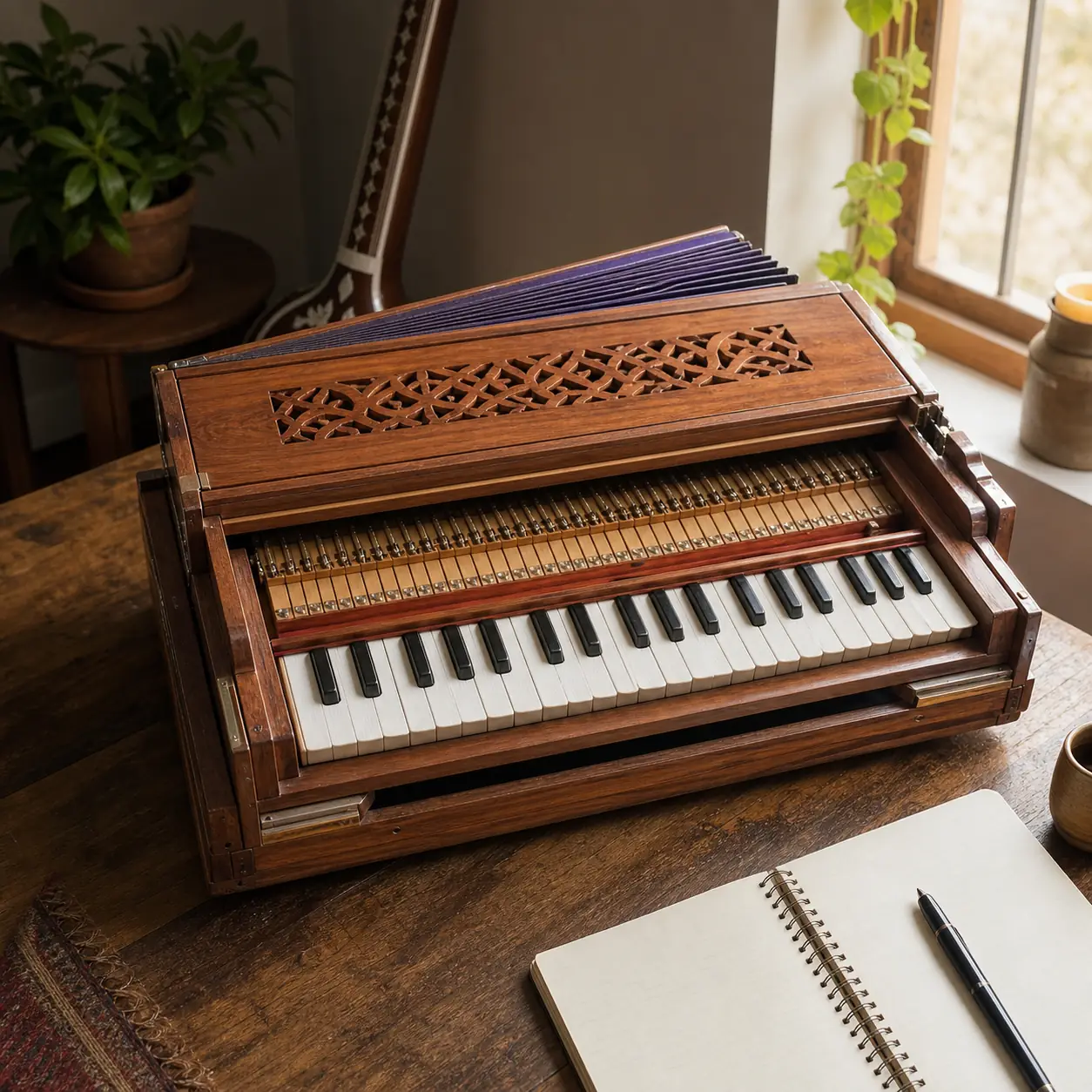
Scale changer harmonium: the quick answer
A scale changer harmonium is a harmonium whose keyboard or key carriage can shift to transpose the instrument. The player can keep a familiar hand pattern while moving the sounding pitch to suit a singer, a recording, or another accompaniment setting.
The feature is most useful when transposition happens often. It is usually unnecessary for a beginner who is still learning note names, choosing Sa, and building a steady bellows and fingering routine. A well-tuned fixed-key instrument is often the better first purchase.
Do not confuse a scale changer with a simple transpose button on a browser instrument. A physical mechanism moves or repositions the keyboard relationship to the reeds; it does not make the harmonium a piano, and it does not remove the need to understand Sa, note names, and musical context. If you are comparing total budget first, start with the harmonium price guide. If you are deciding between features, the beginner buying guide gives the broader checklist.
The exact number of positions varies by model and seller. Listings may use terms such as scale changer, double scale, or multiple-scale harmonium, and the labels are not always used consistently. Ask the seller to demonstrate the mechanism on the exact unit, confirm the available positions, and listen for even tone before treating the name as proof of quality.
What does a scale changer do?
The simplest way to understand the mechanism is to separate fingering from pitch center. On a fixed harmonium, a chosen key and its reed layout stay in one physical relationship. On a scale changer, the keyboard assembly can slide or change position so the same visible hand shape can produce a different starting pitch. The musical phrase still needs to be understood; the machine only changes the physical relationship.
This can save time for an accompanist who supports singers with different comfortable ranges. Instead of relearning a familiar phrase on a new group of keys, the player may move the scale position and keep much of the same muscle memory. That convenience is practical, not magical: the voice, raga, melody, and tuning still have to be checked by ear.
A scale changer does not automatically improve reed quality, bellows response, key action, or tuning stability. In fact, the additional rails, locks, and moving parts create more places where poor construction or rough handling can cause noise and playability problems. Treat the mechanism as one feature in a complete instrument, not as a substitute for a good instrument.
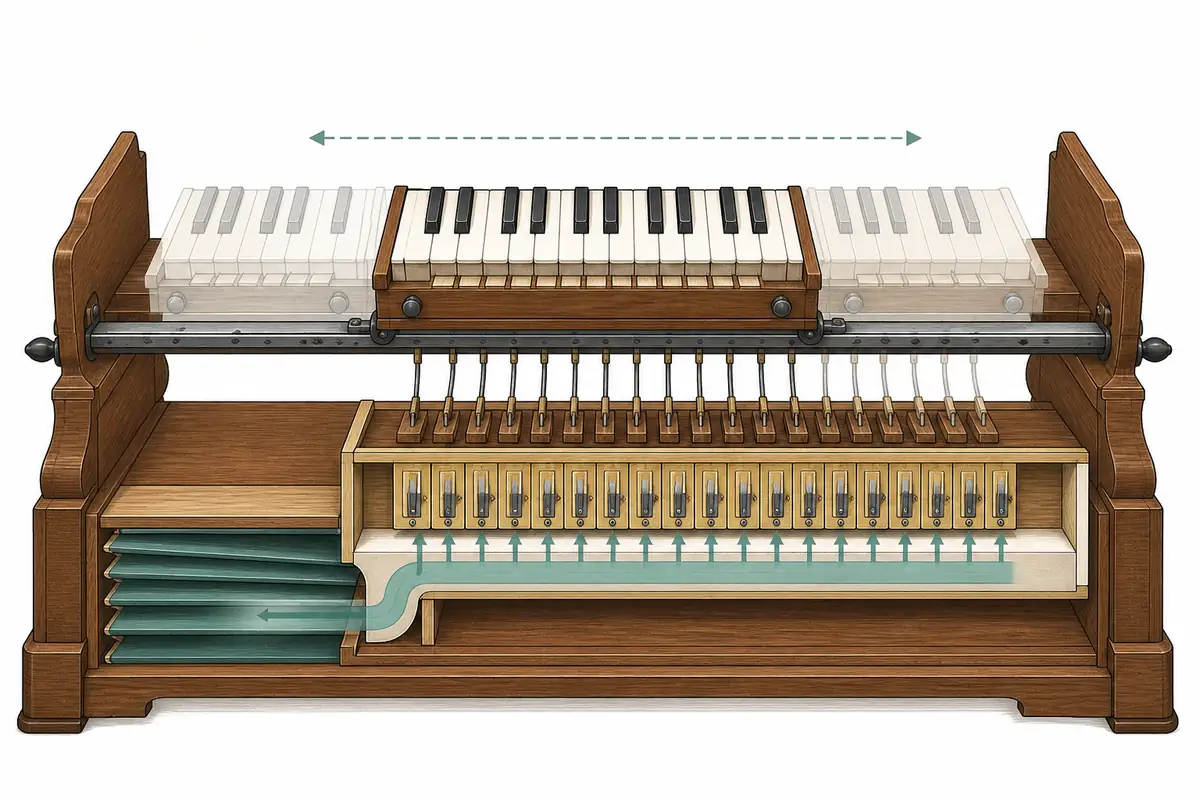
Practical check: move the mechanism slowly while the instrument is closed or supported as the maker instructs. Never force a lock, drag a loaded key carriage, or assume every model uses the same release method.
Musical check: play the same short Sa Re Ga phrase before and after changing position. Listen for the new pitch center, even response, unwanted rattles, and keys that fail to return cleanly.
Fixed-key vs scale changer harmonium
A fixed-key harmonium is simpler to understand and usually easier to compare across sellers. A scale changer can be more flexible for accompaniment, but its value depends on how often you really transpose. The table below is a decision aid, not a ranking of every harmonium on the market.
If your current problem is that you do not know which note to press, a scale changer will not solve it. Learn a stable note map first with the harmonium notes for beginners guide. If your problem is that a singer regularly needs a different starting pitch while you want to keep a familiar phrase shape, the mechanism becomes more relevant.
| Feature | Fixed-key harmonium | Scale changer harmonium | What it means |
|---|---|---|---|
| Keyboard relationship | Stays in one position | Can shift between supported positions | The changer can reduce repeated relearning for transposition |
| Learning curve | Straightforward for a first instrument | Adds a mechanism to understand and maintain | Beginners should value clarity before extra options |
| Weight and cost | Often lower for similar build quality | Usually higher because of rails, locks, and construction | Compare the whole instrument, not only the feature name |
| Best use | Home practice, lessons, fixed repertoire | Frequent accompaniment and changing vocal ranges | Buy for a repeated use case rather than prestige |
| Main risk | Limited physical transposition | Rattle, stiffness, alignment, or weak tone if poorly built | Test the exact unit before paying or shipping it |
Who should buy one—and who should skip it?
A scale changer is worth serious consideration when you accompany more than one singer, move between rehearsals with different pitch centers, or already have a dependable phrase vocabulary that you want to transpose quickly. It can also make sense for a teacher who demonstrates the same exercise in several starting pitches during lessons.
Skip the feature when you are buying your first harmonium, mostly play one fixed repertoire, or have not yet learned the basic note map. A reliable fixed harmonium with even reeds, smooth bellows, and predictable key action will usually teach more than a complicated instrument that feels impressive but is difficult to inspect.
Before choosing, identify the job in one sentence. ‘I need to support singers in different keys every week’ is a real use case. ‘I heard that double scale is better’ is not yet a buying reason. If the feature does not change what you do in a normal practice week, put the money into tuning, service access, protection, and a better daily setup instead.
-
1
Name the transposition problem
Write down the singers, songs, or lesson situations that actually require a different pitch center.
-
2
Test your current note map
Play one familiar phrase and confirm that the difficulty is pitch choice, not uncertain Sa Re Ga Ma reading.
-
3
Compare the added weight
Ask whether you will carry the instrument, store it safely, and pay for service on the moving mechanism.
-
4
Buy the whole instrument
Reject a changer model with uneven reeds, leaking bellows, noisy locks, or poor seller support even if the feature works.
Scale changer harmonium buying checklist
Ask for a demonstration of the exact harmonium, not only a stock video. The keyboard should move through every advertised position without scraping, sudden resistance, or a lock that feels unsafe. Test the same short phrase at two positions and listen for a stable tone after the mechanism is secured.
Inspect the ordinary harmonium parts at the same time. Open and close the bellows, check whether the keys return evenly, listen for hissing air, test the stops one at a time, and ask how the instrument is packed for transport. A scale changer cannot compensate for a reed bank that is out of balance or bellows that leak.
If you buy online, request the model name, number of positions, octave range, reed configuration, dimensions, weight, warranty or repair route, and a current recording of the exact unit. Keep written confirmation of what the seller means by ‘scale changer’ because names such as double scale can describe different constructions.
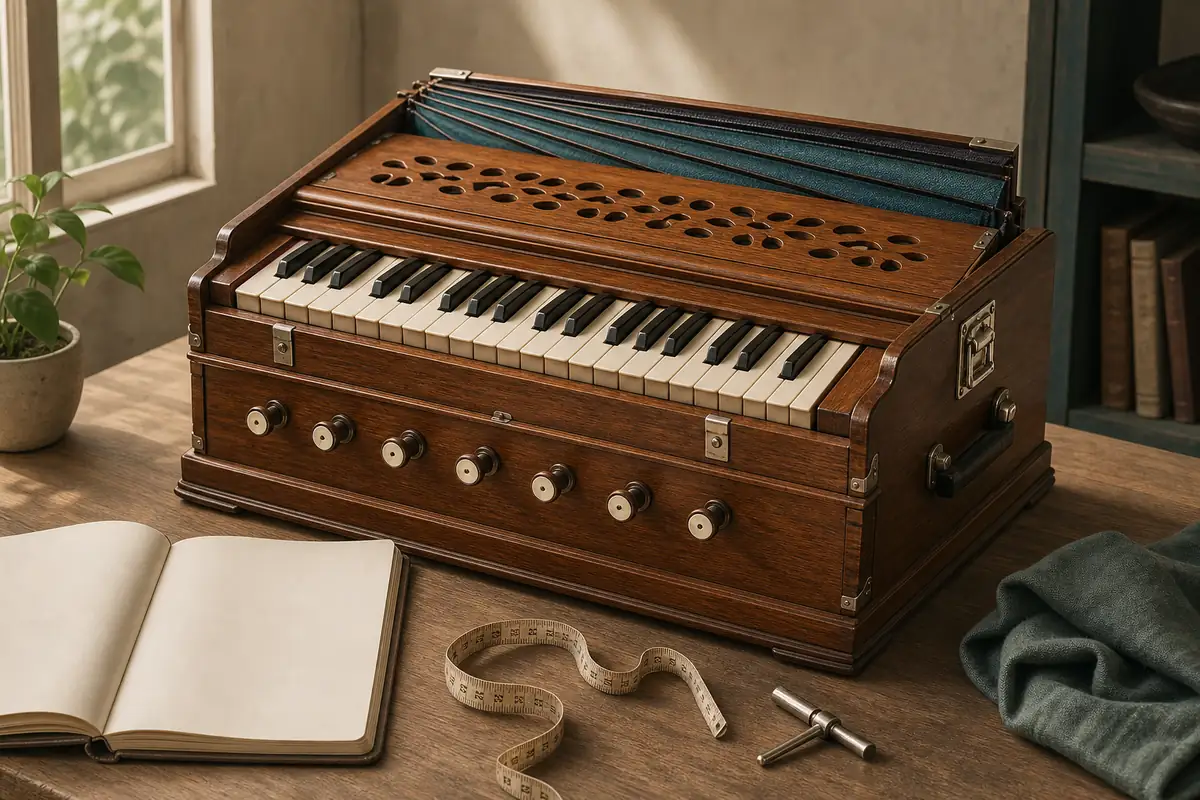
| Check | Why it matters | Red flag |
|---|---|---|
| Changer rail and lock | The keyboard must hold a position without movement or rattle | Grinding, loose lock, or a seller who will not demonstrate it |
| Reeds and tone | Transposition is useful only when every position sounds even | One register is weak, sharp, buzzy, or much louder |
| Bellows and air | Steady air keeps notes usable while you test phrases | Hissing, collapsing folds, or a note that fades too quickly |
| Keys and return | Uneven action makes a familiar fingering unreliable | Sticking keys, uneven height, or delayed return |
| Range and positions | The advertised setup must fit your repertoire and singers | Unclear position count, octave range, or pitch explanation |
| Service and transport | Moving parts need safe packing and a repair path | No parts support, vague warranty, or unsafe shipping plan |
Price, weight, tuning, and maintenance trade-offs
There is no universal price premium for a scale changer harmonium because reed quality, woodwork, octave range, brand, location, and service all change the total. Similarweb shows strong demand around ‘harmonium price’ and smaller but focused demand around ‘scale changer harmonium price’; use those phrases as a reminder to compare a complete specification, not a single headline number.
The moving carriage can add weight and may make the instrument less convenient for travel. It can also change how the case must be supported and how the keyboard is locked before transport. Ask whether the seller recommends a particular carrying position, whether the mechanism is user-serviceable, and what parts are available if alignment changes.
Tuning is still a separate question. A scale changer can alter the pitch relationship used by the keyboard, but it does not guarantee that every reed is tuned evenly or that every position is equally pleasant. Listen in the registers you will actually use, and have a qualified harmonium technician inspect a costly instrument when the seller cannot answer basic construction questions.
Budget rule: if the changer consumes the money you needed for stable reeds, a good case, local service, or a teacher's inspection, choose the simpler instrument first.
Maintenance rule: do not oil, bend, or force a rail because a generic video recommends it. Follow the maker's instructions or use a technician familiar with the exact construction.
How to practice without confusing transposition
Treat the scale changer as a transposition aid, not as a replacement for note knowledge. Choose one position as your reference, name the notes while playing, and keep a short phrase that you can recognize by ear. Only then move the mechanism and check what changed.
A useful exercise is to play Sa Re Ga Ma, a two-bar melody, or a simple chord support pattern in the reference position. Move to another position, find the new Sa, and play the same pattern slowly. If the phrase sounds wrong, stop and identify whether the problem is the new pitch center, a mechanical lock, or a notation mistake.
For chord work, remember that transposition does not turn a harmonium into a piano. Use the beginner harmonium chords guide for root-third-fifth shapes and accompaniment boundaries, then test the result with the singer or melody rather than trusting the mechanism alone.
-
1
Choose one reference position
Set a comfortable Sa and write down the phrase or chord pattern you will compare.
-
2
Play slowly and name notes
Keep the phrase short enough to hear every note and avoid changing several controls at once.
-
3
Move and lock the mechanism
Use the maker's release and lock method; do not force the carriage or play while it is unsecured.
-
4
Find the new pitch center
Listen for Sa again, then repeat the same phrase with the same musical intention.
-
5
Return to the reference
Switch back and confirm that the original position still sounds and feels normal.
Use Web Harmonium before buying a scale changer
A browser harmonium cannot reproduce the weight, bellows pressure, key travel, or mechanical feel of a physical scale changer. It can still help you answer the musical question first: do you actually need to move the pitch center while keeping a familiar phrase shape? Use the online harmonium to test a short melody with transpose and octave controls before you spend on extra hardware.
If the note map is unclear, read the English-key harmonium guide or the Sargam notes guide. If you mainly practice at a desk, the laptop harmonium guide shows how QWERTY and MIDI can test a phrase without pretending to replace a physical instrument.
Before purchase, compare a current seller specification with an independent buying guide such as India Instruments' harmonium purchase guide. Product pages and demonstrations can show the feature, but the final decision should still include your own use case, service access, and an inspection of the exact harmonium.
Scale changer harmonium FAQ
What is a scale changer harmonium?
It is a harmonium with a movable or repositionable keyboard mechanism that can shift the pitch relationship between the keys and reeds. The goal is to help a player transpose a familiar fingering pattern, especially when accompanying singers in different ranges.
Is a scale changer harmonium better for beginners?
Usually not by default. Beginners often benefit more from stable tuning, even reeds, smooth bellows, clear keys, and accessible service. Choose a scale changer only when you already have a repeated transposition need and understand how to test the mechanism.
What is the difference between a scale changer and a double scale harmonium?
The terms are related but seller usage is not perfectly consistent. A double-scale model generally advertises more than one scale position, while scale changer is the broader feature name. Confirm the exact number of positions and how they work on the model you are considering.
How do I identify a scale changer harmonium?
Look for a keyboard carriage, release, rail, or locking mechanism that can move to a different position. Do not rely on the listing title alone: ask the seller to demonstrate every advertised position and explain the pitch relationship in writing.
Does a scale changer change the tuning of the reeds?
It changes the keyboard-to-pitch relationship used for transposition, but it does not guarantee that the reeds are well tuned. A changer model can still have uneven, noisy, or poorly maintained reeds, so listen to the exact instrument and inspect it separately.
Can I practice a scale changer harmonium online first?
You can test the musical idea with an online harmonium's transpose and octave controls, note maps, and short phrases. A browser tool cannot reproduce physical bellows, key resistance, or the feel of moving and locking a real keyboard carriage.
Test the pitch question before you buy
Open Web Harmonium, choose one short phrase, and use transpose to decide whether a physical scale changer would solve a real practice problem for you.
Open Web Harmonium